SHINING 3D Photogrammetry in Dental Implant Treatment
Successful full-arch implant treatment depends on more than placing dental implants in suitable positions. The position and angle of each implant must also be transferred accurately to the digital design of the temporary or final restoration.
SHINING 3D intraoral photogrammetry helps clinicians record the three-dimensional positions of multiple implants across a complete dental arch. This digital information can then be combined with scans of the gums, bite and surrounding oral structures to support the design of an implant-supported bridge.
At DIS Levent International, photogrammetric implant scanning may be incorporated into selected All-on-4, All-on-6 and other full-mouth dental implant treatments in Istanbul.
What Is Dental Photogrammetry?
Photogrammetry is a measurement method that calculates the position of an object using optical images captured from different angles.
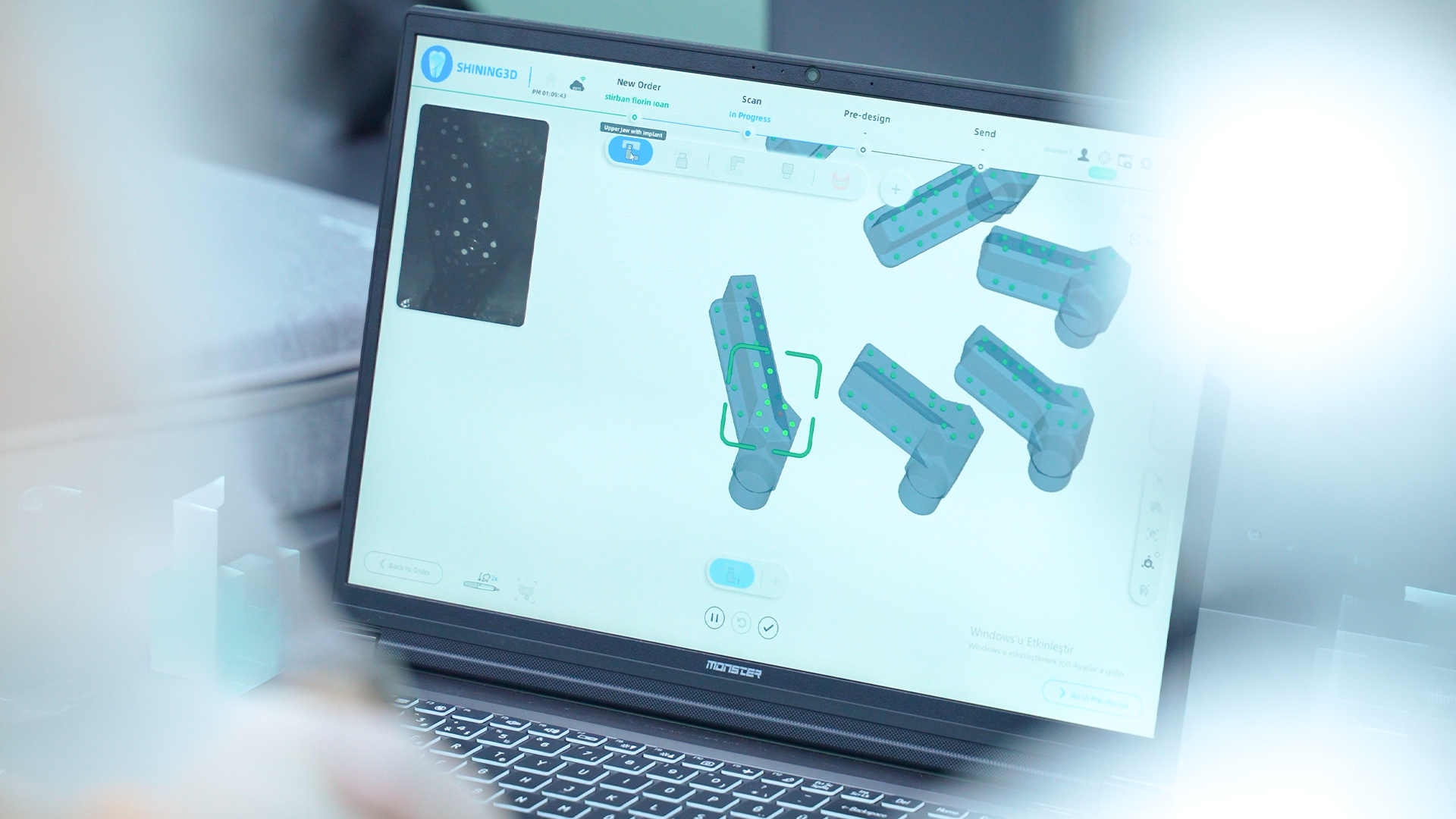
In implant dentistry, specially coded scan bodies are attached to the implants or multi-unit abutments. The SHINING 3D system recognises the coded surfaces and calculates the position, distance and angle of each implant in relation to the others.
Unlike a conventional impression, the information is recorded digitally. The resulting data can be transferred directly to the restorative dentist and dental laboratory for computer-aided design and manufacturing.
Why Is an Accurate Implant Impression Important?
A single dental implant covers a relatively limited scanning area. Recording four, five or six implants across a completely edentulous arch is more demanding.
Standard intraoral scanners build a complete digital model by continuously joining multiple images. Across a long, toothless arch, small differences between these images can accumulate. Mobile gum tissue and the absence of natural teeth as visual reference points can also make full-arch scanning more challenging.
Photogrammetry focuses on the coded scan bodies rather than relying only on the surrounding anatomy. This helps establish a reliable digital relationship between implants across the arch.
Accurate implant position records are important when designing a restoration intended to achieve a passive fit. A passive fit means that the full-arch bridge is seated on the implants without avoidable tension being introduced as the screws are tightened.
How Is SHINING 3D Photogrammetry Used?
SHINING 3D Aoralscan Elite combines conventional intraoral scanning with intraoral photogrammetry. However, photogrammetry does not replace examination, CBCT imaging or restorative planning. It forms one part of a complete digital implant workflow.
1. Clinical examination and CBCT imaging
Dental implant treatment begins with an assessment of the patient’s teeth, gums, bite, medical history and available jawbone.
A CBCT scan allows the clinician to evaluate bone volume and its relationship with anatomical structures such as the nerves and sinuses. The number, position and angle of the implants can then be planned according to the surgical and restorative requirements of the case.
Photogrammetry does not replace CBCT imaging. CBCT supports surgical diagnosis and planning, while photogrammetry records the position of the implants after they have been placed.
2. Dental implant placement
The implants or multi-unit abutments are placed according to the individual treatment plan.
If the implants achieve suitable initial stability, a temporary fixed restoration may be considered. Immediate temporary teeth are not appropriate for every patient. The decision depends on implant stability, bone condition, bite forces and other clinical findings.
3. Placement of coded scan bodies
Special coded scan bodies are attached to the implants or multi-unit abutments. Correct seating of these components is essential because the photogrammetry system uses them as reference points.
The SHINING 3D scanner records the coded patterns and calculates the three-dimensional relationship between the implants.
4. Intraoral scanning
Photogrammetry primarily records the positions and angles of the implants. A conventional intraoral scan is also required to capture the gums, surrounding tissues, existing teeth and bite.
The implant-position data and intraoral scan are combined digitally to produce a more complete model for restorative planning.
5. Digital restoration design
The collected information is transferred to the dental laboratory. The temporary or final restoration can then be designed according to:
- Implant positions
- Available restorative space
- Bite and jaw relationship
- Tooth size and shape
- Gum contours
- Lip support
- Facial proportions
- Cleaning access
- Material requirements
The completed restoration must still be clinically assessed. Fit, bite, appearance, screw access and hygiene areas are checked before treatment is finalised.
CBCT, Intraoral Scanning and Photogrammetry: What Is the Difference?
These technologies perform different functions within digital implant treatment.
TechnologyPrimary purpose
- CBCT imaging: Evaluates the jawbone, nerves, sinuses and other anatomical structures.
- Intraoral scanning: Records the teeth, gums, soft tissues and bite digitally.
- Photogrammetry: Records the positions and angles of implants or multi-unit abutments.
- CAD/CAM technology: Uses the collected data to design and manufacture the temporary or final restoration.
Using these records together helps the surgical, restorative and laboratory teams coordinate the different stages of treatment.
Potential Patient Benefits of Photogrammetric Implant Scanning
For suitable full-arch cases, SHINING 3D photogrammetry may provide several benefits:
- Digital recording of multiple implant positions across a complete arch
- Reduced reliance on traditional impression trays and impression materials
- Direct transfer of scan data to the dental laboratory
- A more coordinated digital workflow
- Support for the design of temporary and final restorations
- Fewer manual stages between impression-taking and restoration design
- Potentially fewer repeated impressions or adjustment appointments
- Improved communication between the surgeon, restorative dentist and laboratory
These benefits do not mean that technology alone can guarantee implant success or a perfect-fitting restoration. The result also depends on correct seating of the scan bodies, moisture and bleeding control, implant distribution, clinical technique, software processing and laboratory production.
Is Photogrammetry Required for Every Dental Implant?
Photogrammetry is particularly useful when several implants support the same full-arch restoration. It may be considered for:
- All-on-4 dental implants
- All-on-6 dental implants
- Other All-on-X treatments
- Full-arch fixed implant bridges
- Selected immediate-loading cases
- Long-span, multi-implant restorations
- Fixed titanium-bar-supported restorations
Photogrammetry may not be necessary for a single-tooth dental implant. The most appropriate impression method is selected according to the number of implants, treatment area, implant system and planned restoration.
Dental Implant Treatment in Istanbul: Why Does Digital Measurement Matter?
Patients researching dental implant treatment in Istanbul often compare implant brands and advertised prices. However, the method used to plan the surgery, record the implant positions and manufacture the final teeth is equally important.
When comparing dental implant treatment in Turkey, international patients should ask:
- Who will perform the surgery and restorative treatment?
- Which implant brand and model will be used?
- Will an implant passport be provided?
- Are CBCT imaging and digital scans available within the clinic?
- Which impression method will be used for a full-arch restoration?
- Are temporary fixed teeth included?
- Which material will be used for the final restoration?
- Where will the restoration be manufactured?
- How many visits and nights in Istanbul will be required?
- What follow-up support is available after returning home?
Digital technology can support a more coordinated treatment process, but it does not replace diagnosis, clinician experience, suitable patient selection or long-term maintenance.
SHINING 3D Technology at DIS Levent International
At DIS Levent International, dental implant treatment is coordinated between oral and maxillofacial surgery, implant dentistry, restorative dentistry and the dental laboratory.
For suitable full-arch cases, SHINING 3D photogrammetry can be used to transfer the positions of the implants into the digital restorative workflow. Photogrammetric records may be combined with CBCT imaging and intraoral scans when planning temporary and final teeth.
The same scanning method is not automatically used for every patient. The number of implants, implant stability, soft-tissue condition and planned restoration are evaluated before the appropriate impression technique is selected.
Frequently Asked Questions
Is photogrammetric implant scanning painful?
Photogrammetric scanning is not a surgical procedure. Special scan bodies are attached to the implants or multi-unit abutments before the optical scan is completed. The experience is generally similar to having a digital intraoral scan.
Some sensitivity may be present when the scan is performed immediately after implant surgery.
Is photogrammetry the same as a CBCT scan?
No. A CBCT scan is used to assess the jawbone, nerves, sinuses and other anatomical structures. Photogrammetry records the three-dimensional positions and angles of implants that have already been placed.
The two technologies are used for different but complementary purposes.
Does SHINING 3D replace conventional implant impressions?
For suitable cases, photogrammetry can provide a digital alternative to a conventional full-arch implant impression. However, the selected technique depends on the number of implants, treatment stage, implant components and clinical conditions.
Can photogrammetry provide same-day permanent teeth?
Photogrammetry can help streamline the measurement and design process, but it does not guarantee same-day permanent teeth.
Selected patients may receive a temporary fixed restoration when sufficient implant stability is achieved. The final restoration is commonly prepared after the implants have integrated with the jawbone and the surrounding tissues have healed.
Does photogrammetry improve the fit of full-arch implant teeth?
Photogrammetry is designed to record the relative positions of multiple implants accurately and can support the production of a well-fitting restoration. However, the final fit also depends on clinical technique, digital design, manufacturing and appropriate quality checks.
Does SHINING 3D photogrammetry affect the cost of dental implants in Turkey?
The total cost depends on the number and brand of implants, the restoration material, any additional surgical procedures, temporary teeth and laboratory requirements.
Whether photogrammetric scanning is included should be clearly stated in the patient’s personalised treatment plan and itemised quotation.
Start Your Dental Implant Assessment in Istanbul
If you are considering single, multiple or full-mouth dental implants in Istanbul, you can share your recent dental X-rays, photographs and treatment records with our international patient team.
Our clinical team will review the available information and explain the possible implant options, expected number of visits, estimated treatment timeline and whether SHINING 3D photogrammetry may be appropriate for your case.
Your final treatment plan and cost will be confirmed after an in-clinic examination and three-dimensional assessment in Istanbul.
This guide provides general information. Your dentist must confirm whether a treatment is suitable after a clinical examination and diagnostic imaging.
Blog