
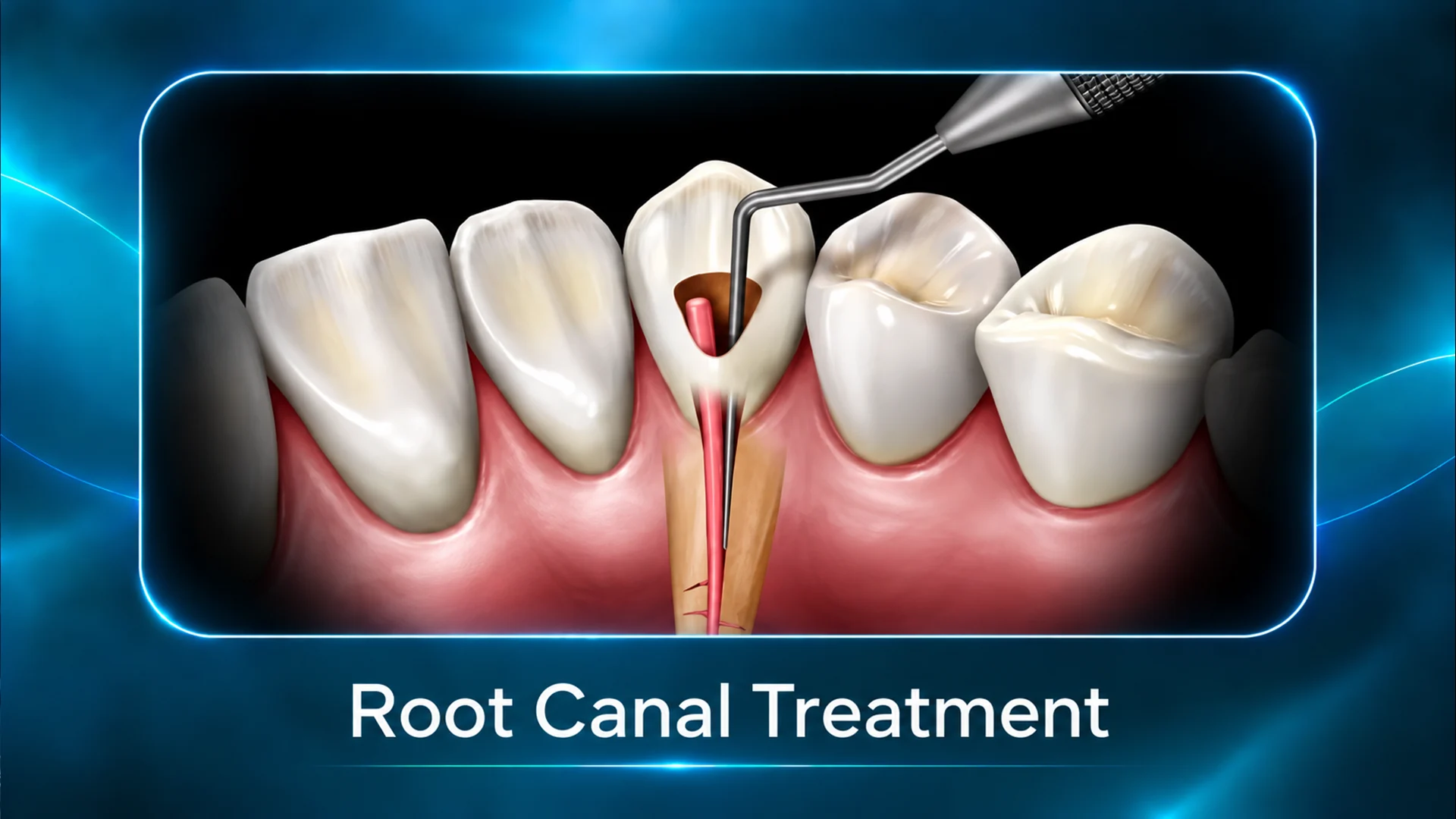
What Is Root Canal Treatment?
Root canal treatment, also known as endodontic treatment, is used when the soft tissue inside a tooth becomes irreversibly inflamed, infected or damaged.
This soft tissue is called the dental pulp. It contains nerves, blood vessels and connective tissue and extends from the centre of the tooth through narrow channels within the roots.
Deep decay, cracks, trauma, leaking restorations or repeated dental procedures can allow bacteria or irritation to reach the pulp. When the pulp cannot recover, root canal treatment may be required to preserve the tooth.
During treatment, the dentist:
- Accesses the pulp chamber inside the tooth.
- Removes inflamed, infected or non-vital pulp tissue.
- Cleans and shapes the root canals.
- Disinfects the internal canal system.
- Fills and seals the cleaned canals.
- Restores the opening with a filling or temporary material.
- Plans the final filling or crown required to protect the tooth.
The purpose of treatment is not to remove the tooth. It is to treat the inside of the tooth so that the natural tooth can remain in the mouth and continue to function.
Signs You May Need Root Canal Treatment
Symptoms vary according to the condition of the dental pulp and surrounding tissues. Some teeth cause severe discomfort, while others may have little or no pain despite an infection being visible on an X-ray.
Possible signs include:
- Persistent or severe toothache.
- Pain when biting or chewing.
- Sensitivity to hot or cold that continues after the stimulus has been removed.
- Swelling or tenderness around a tooth.
- A small pimple or draining area on the gum.
- Darkening of a tooth.
- A cracked or heavily damaged tooth.
- Deep decay close to the dental pulp.
- Pain that spreads towards the jaw, ear or surrounding teeth.
- A previously treated tooth developing new symptoms.
These symptoms do not automatically mean that root canal treatment is required. Tooth sensitivity, gum problems, bite-related pain and other dental conditions can produce similar symptoms.
A clinical examination and dental X-ray are required before a diagnosis is made.
WHEN SHOULD I SEEK URGENT CARE?
Seek urgent dental or medical care if you experience:
- Rapidly increasing facial or dental swelling.
- Swelling extending towards the eye, neck or jaw.
- Fever or feeling significantly unwell.
- Difficulty swallowing or breathing.
- Severe pain that cannot be controlled.
- Trauma resulting in a broken or displaced tooth.
Do not postpone urgent treatment while waiting to travel internationally. The immediate priority is controlling pain, swelling and the risk of infection spreading.
How Is the Need for Root Canal Treatment Diagnosed?
A root canal diagnosis is based on your symptoms, dental history, clinical tests and imaging. Pain alone cannot show which tooth is responsible or whether the pulp can recover.
The assessment may include:
- Discussing when the pain began and what triggers it.
- Examining the tooth for decay, cracks or failed restorations.
- Checking the surrounding gums and soft tissues.
- Testing the tooth’s response to temperature or other vitality tests.
- Tapping the tooth and evaluating tenderness.
- Assessing the bite and pressure on the tooth.
- Taking a dental X-ray.
- Using CBCT imaging when complex anatomy or previous treatment requires additional three-dimensional information.
The dentist determines whether the pulp is healthy, reversibly irritated, irreversibly inflamed or no longer vital.
If the pulp can recover, a filling or another conservative treatment may be sufficient. Root canal treatment is recommended when the pulp cannot heal predictably and the tooth remains restorable.
Types of Root Canal and Endodontic Treatment
INITIAL ROOT CANAL TREATMENT
This is the first root canal procedure performed on a tooth. The pulp tissue is removed, and the root canals are cleaned, shaped, disinfected and sealed.
The complexity depends on the number, shape and position of the canals.
SINGLE-CANAL ROOT CANAL TREATMENT
Front teeth often have simpler root anatomy and may contain a single main canal. Suitable cases can sometimes be completed during one appointment.
The actual anatomy must still be confirmed through examination and imaging.
MULTI-CANAL ROOT CANAL TREATMENT
Premolars and molars can have several canals, narrow areas, curves and anatomical variations.
These teeth may require longer appointments or more than one visit to clean and seal the complete canal system.
ROOT CANAL RETREATMENT
A previously treated tooth can occasionally develop new symptoms or fail to heal as expected. This may happen because of complex anatomy, a missed canal, leakage, new decay, a damaged restoration or reinfection.
During retreatment, the previous root filling is removed, the canal system is reassessed and cleaned, and the canals are filled and sealed again.
EMERGENCY ENDODONTIC TREATMENT
When a patient presents with severe pain or pressure, the first appointment may focus on opening the tooth, removing inflamed tissue or draining infection to control the immediate symptoms.
The remaining root canal stages are then completed according to the clinical plan.
APICAL SURGERY
If infection persists around the tip of a root after conventional treatment or retreatment, endodontic surgery may be considered in selected cases.
This is not required for routine root canal treatment. The available options are discussed only when conventional access through the tooth cannot resolve the problem predictably.
Root Canal Treatment Procedure: Step by Step
CLINICAL EXAMINATION AND IMAGING
The dentist examines the tooth, reviews your symptoms and takes the necessary X-rays. CBCT imaging may be used when a three-dimensional view of complex anatomy is clinically helpful.
The condition of the tooth, roots, surrounding bone and previous restorations is evaluated.
LOCAL ANAESTHESIA
Local anaesthesia is administered to numb the tooth and surrounding tissues.
Patients may feel pressure or movement during treatment, but they should not feel sharp procedural pain. If you remain uncomfortable, tell the dentist so that additional anaesthesia or another comfort measure can be considered.
ISOLATION OF THE TOOTH
The treatment area is isolated to keep the tooth clean and reduce contamination from saliva.
This also helps prevent small instruments and cleaning solutions from contacting other areas of the mouth.
ACCESS TO THE PULP CHAMBER
A controlled opening is created through the tooth or existing restoration to reach the pulp chamber and root canals.
The location and size of the opening depend on the anatomy and condition of the tooth.
REMOVAL OF INFLAMED OR INFECTED TISSUE
The damaged pulp tissue is removed from the chamber and root canals.
The dentist identifies the canals and determines their working length so they can be cleaned throughout the required area.
CLEANING, SHAPING AND DISINFECTION
The canals are carefully cleaned and shaped using endodontic instruments and disinfecting solutions.
This stage removes tissue and reduces bacteria while creating a suitable shape for the root filling material.
ROOT CANAL FILLING
Once the canals are ready, they are filled and sealed with a biocompatible root-filling material.
The objective is to close the prepared canal space and reduce the risk of bacteria entering it again.
TEMPORARY OR PERMANENT RESTORATION
The access opening is closed with a temporary or permanent filling, depending on the treatment stage.
If another appointment is required, the temporary restoration protects the tooth between visits. Avoid placing excessive pressure on the tooth until the final restoration has been completed.
FINAL FILLING OR CROWN
After root canal treatment, the tooth is restored according to the amount of structure remaining and its position in the mouth.
A filling may be appropriate for some teeth. A crown or another protective restoration may be recommended when the tooth has lost more structure or is exposed to greater chewing forces.
Is Root Canal Treatment Painful?
The reputation of root canal treatment is often connected to the pain caused by an inflamed or infected tooth rather than the procedure itself.
Root canal treatment is normally carried out under local anaesthesia. The treatment area is numbed before the dentist begins, helping patients remain comfortable during the procedure.
You may feel pressure, vibration or movement, but you should not feel sharp pain. Inflamed teeth can occasionally be more difficult to numb, which is why communication with the dentist throughout treatment is important.
Mild tenderness or sensitivity when biting can occur for a few days afterwards. This may be related to inflammation in the tissues surrounding the root rather than the nerve tissue that has been removed from inside the tooth.
Your dentist provides individual instructions for managing discomfort. Contact the clinic if pain becomes more intense, lasts longer than expected or is accompanied by visible swelling.
How Long Does Root Canal Treatment Take in Turkey?
Root canal treatment is commonly completed in one or two appointments. The duration and number of visits depend on:
- Whether the tooth is a front tooth, premolar or molar.
- The number and shape of the root canals.
- The extent of inflammation or infection.
- Whether the tooth has been treated previously.
- Whether medication is placed inside the tooth between visits.
- The condition of the existing filling or crown.
- Whether a final crown or other restoration is required.
SINGLE-VISIT ROOT CANAL TREATMENT
Selected teeth can be cleaned, shaped, disinfected and filled during one appointment.
This may be possible when the anatomy is manageable, the tooth can be adequately disinfected and the clinical findings support completing treatment on the same day.
TWO OR MORE APPOINTMENTS
A temporary filling and medication may be used between visits when the tooth has complex anatomy, significant infection, persistent drainage or requires additional disinfection.
Retreatment can also require more time because the existing root-filling material and restorations may need to be removed.
TREATMENT FOR INTERNATIONAL PATIENTS
Routine root canal treatment does not normally require an extended stay in Türkiye. Treatment may be completed in one or two appointments over several days.
If the tooth also requires a custom-made crown, the complete root canal and restorative process may take approximately five to seven working days. The schedule is confirmed after examination and coordinated around your travel plans.
Do I Need a Filling or Crown After Root Canal Treatment?
Completing the root canal is only one part of preserving the tooth. The access opening and missing tooth structure must also be restored to protect the tooth and reduce the risk of bacteria entering the canal system again.
FINAL FILLING
A filling may be suitable when the tooth has enough healthy structure remaining and is not exposed to excessive chewing forces.
This may be considered for some front teeth and smaller access cavities.
DENTAL CROWN
A crown may be recommended when the tooth is:
- A premolar or molar exposed to stronger chewing forces.
- Heavily filled or structurally weakened.
- Cracked or significantly worn.
- Missing a large amount of natural structure.
- Already prepared for a previous crown.
- Considered at greater risk of fracture.
A root-canal-treated tooth does not automatically require the same restoration in every case. The decision depends on remaining tooth structure, tooth position, bite and long-term fracture risk.
When a crown is required, the material-such as monolithic zirconia or E-max-is selected according to the tooth’s position, underlying colour, restorative needs and bite forces.
Explore Zirconium Crowns in Turkey Explore E-max Crowns in TurkeyHow Much Does Root Canal Treatment Cost in Turkey?
The cost of root canal treatment in Turkey depends on the tooth, canal anatomy, infection and whether previous treatment must be removed.
Factors affecting the price can include:
- Whether the tooth is a front tooth, premolar or molar.
- The number and complexity of the canals.
- Initial root canal treatment or retreatment.
- Emergency treatment before completion.
- Dental X-rays or CBCT imaging.
- Removal of an old filling, post or crown.
- Medication placed between appointments.
- Core build-up after treatment.
- Temporary filling or temporary crown.
- Final filling, onlay or dental crown.
- Additional treatment for a cracked or damaged tooth.
An advertised root canal price may include only the endodontic procedure and not the final filling or crown. Patients should therefore request an itemised treatment plan explaining each stage.
TRANSPARENT TREATMENT PLAN
Before travelling, you can send recent X-rays, photographs and dental reports for a preliminary assessment.
You receive an initial plan explaining the expected root canal procedure, number of visits and possible final restoration. Costs that could change according to the clinical examination are discussed in advance.
The final plan and price are confirmed after the tooth has been examined in Istanbul. If unexpected findings require a change, the reason and available options are explained before treatment continues.
Benefits of Root Canal Treatment
PRESERVING THE NATURAL TOOTH
The main purpose of root canal treatment is to retain a natural tooth that might otherwise need to be extracted.
TREATING THE SOURCE OF DENTAL PAIN
Removing irreversibly inflamed or infected pulp tissue can address the source of persistent toothache and biting discomfort.
MAINTAINING CHEWING FUNCTION
Once treatment and the final restoration are complete, the tooth can continue to support biting and chewing.
AVOIDING A GAP OR TOOTH REPLACEMENT
Preserving the tooth may avoid the need to replace it with an implant, bridge or removable prosthesis.
Not every tooth can or should be retained, but extraction should not be selected before the tooth’s restorative potential has been assessed.
SUPPORTING THE SURROUNDING DENTITION
Keeping a restorable natural tooth helps maintain the existing contact with neighbouring and opposing teeth.
COMBINED ENDODONTIC AND RESTORATIVE CARE
Root canal treatment can be coordinated with the filling, crown or other restoration required to return the tooth to function.
Root Canal Recovery and Aftercare
The treated tooth and surrounding tissues may feel tender for a few days. This is generally manageable and should gradually improve.
Aftercare recommendations may include:
- Waiting until the local anaesthesia has worn off before chewing.
- Avoiding biting your lip, cheek or tongue while the area is numb.
- Taking prescribed or recommended medication exactly as directed.
- Avoiding hard or sticky foods on a temporary filling or crown.
- Chewing on the opposite side until the final restoration is completed.
- Brushing and cleaning between the teeth as instructed.
- Keeping the area around the treated tooth clean.
- Returning for the planned final filling or crown.
- Attending follow-up X-rays when recommended.
- Contacting the clinic if symptoms return or worsen.
CONTACT THE CLINIC IF:
- Severe pain or pressure continues or becomes worse.
- Visible swelling develops.
- Your bite feels uneven or the tooth contacts first.
- A temporary filling or crown comes out.
- Your original symptoms return.
- You experience a reaction to prescribed medication.
- You develop fever or feel generally unwell.
Do not delay the final restoration. A root-canal-treated tooth with an incomplete or leaking restoration can become contaminated again or fracture under chewing pressure.
Root Canal Risks and Important Considerations
Root canal treatment is intended to preserve a tooth, but no dental procedure can guarantee that every tooth will heal or remain functional for life.
Possible complications can include:
- Persistent inflammation or infection.
- Complex, narrow, curved or missed canals.
- Difficulty removing previous root-filling material.
- Separation of an instrument within the canal.
- Perforation or damage to the root.
- Fracture of the remaining tooth structure.
- Leakage beneath a filling or crown.
- Reinfection caused by new decay or a damaged restoration.
- Continued symptoms requiring reassessment.
- The need for retreatment or endodontic surgery.
- Extraction if the tooth cannot be restored or infection cannot be resolved predictably.
These risks do not mean treatment is expected to fail. They show why accurate diagnosis, complete canal cleaning, effective sealing and a timely final restoration are important.
Long-term outcomes also depend on the tooth’s original condition, root anatomy, remaining structure, oral hygiene and regular dental care.
Root Canal Treatment vs Tooth Extraction
Root canal treatment and extraction address different clinical situations. When a tooth is restorable, root canal treatment may allow it to remain in the mouth. Extraction removes the entire tooth and may create a space requiring replacement.
ROOT CANAL TREATMENT MAY BE CONSIDERED WHEN:
- The infection or inflammation is within the pulp or root-canal system.
- The tooth has enough healthy structure to be restored.
- The root is not fractured beyond repair.
- The supporting bone and gums allow the tooth to remain functional.
- A predictable final filling or crown can be provided.
EXTRACTION MAY BE CONSIDERED WHEN:
- The tooth is fractured or damaged beyond restoration.
- Decay extends too far below the gum.
- There is not enough tooth structure to support a restoration.
- Severe periodontal disease has significantly reduced support.
- Previous treatment cannot be predictably revised.
- Preserving the tooth would not offer a reasonable long-term outcome.
An extracted tooth may later be replaced with a dental implant, bridge or removable prosthesis. These options involve their own treatment stages, costs and maintenance requirements.
The goal is not to retain every tooth at any cost. It is to make a balanced decision based on whether the tooth can be treated and restored predictably.
Explore Dental Implant Treatment in TurkeyWhy Do International Patients Consider Root Canal Treatment in Turkey?
International patients may consider root canal treatment in Turkey because private endodontic and restorative care can be more accessible than comparable private treatment in the UK, Europe or the United States.
Patients may also value:
- Access to endodontic and restorative care in the same clinic.
- Digital dental imaging and in-clinic CBCT when required.
- Coordination of root canal treatment and the final crown.
- Treatment schedules planned around a limited stay.
- Multilingual communication and patient support.
- Itemised treatment planning before travelling.
- The possibility of completing treatment without a prolonged stay.
Price should not be the only factor. Patients should compare the diagnosis, treating clinician, imaging, isolation protocol, proposed final restoration and follow-up arrangements.
Severe pain, swelling, fever or spreading infection should be treated urgently where you are. Do not delay emergency care solely to arrange treatment abroad.
Why Choose DIS Levent International for Root Canal Treatment in Istanbul?
Root canal treatment must address both the infection inside the tooth and the restoration required afterwards. Treating the canals without planning how the tooth will be rebuilt can leave the final result incomplete.
At DIS Levent International, endodontic and restorative stages are coordinated within the same clinic.
TOOTH-PRESERVING ASSESSMENT
Our first objective is to determine whether the tooth can be preserved predictably.
Root canal treatment is not recommended automatically for every painful tooth, and extraction is not recommended before the tooth’s restorative potential has been assessed.
ENDODONTIC AND RESTORATIVE CARE IN ONE CLINIC
The clinician performing or coordinating the root canal treatment can communicate directly with the dentist responsible for the final filling or crown.
This allows the internal treatment, remaining tooth structure, bite and final restoration to be considered together.
DIGITAL IMAGING WITHIN THE CLINIC
Digital X-rays are used to evaluate the tooth and monitor treatment. When a complex canal system, previous root canal treatment or another clinical concern requires additional detail, CBCT imaging can be taken within our clinic.
This avoids referring international patients to a separate imaging centre and helps the team coordinate diagnosis and treatment efficiently.
PERSONALISED FINAL RESTORATION
Not every root-canal-treated tooth requires the same restoration. A filling may be suitable for one tooth, while another may require a core build-up and crown.
Where a crown is required, E-max, monolithic zirconia or another appropriate material is selected according to the tooth’s position, structure and functional demands.
OUR DENTAL LABORATORY
Technology, precision and craftsmanship come together to create personalised dental restorations planned for natural aesthetics, comfortable function and an accurate fit.
When a custom crown is required after root canal treatment, direct communication between the dentist and laboratory team supports the design, fit, shade and bite of the final restoration.
MULTIDISCIPLINARY DENTAL TEAM
A painful or infected tooth may also involve gum disease, a failed crown, a crack, bite problems or another restorative requirement.
At DIS Levent International, professionals working across endodontics, restorative dentistry, periodontology, oral surgery and prosthetic dentistry can assess these needs within the same clinic.
TRANSPARENT TREATMENT PLAN
The root canal procedure, expected appointments and final restoration are explained separately in your treatment plan.
This allows you to understand whether the quotation includes only the root canal or also the filling, core build-up, temporary restoration and final crown.
INTERNATIONAL PATIENT SUPPORT
A member of our international patient team remains available to help with appointments, travel information and communication.
Our English-speaking doctors and multilingual interpreters help you describe your symptoms clearly and understand the diagnosis, treatment alternatives and aftercare instructions.
The international patient team also remains available after you return home and directs clinical questions to the relevant dentist when required.
Root Canal Treatment Results
Root canal treatment results are usually assessed clinically and through dental X-rays rather than conventional smile photographs.
Before-and-after X-rays can demonstrate the cleaned and filled root-canal system, while follow-up imaging helps the dentist monitor healing in the tissues surrounding the roots.
Each tooth begins with different anatomy, infection and restorative conditions. Previous cases do not guarantee that another tooth will have the same treatment or outcome.
Frequently Asked Questions About Root Canal Treatment in Turkey
What is root canal treatment?+
Root canal treatment removes inflamed, infected or non-vital pulp tissue from inside a tooth. The canals are then cleaned, shaped, disinfected, filled and sealed so that the natural tooth can be retained when it remains restorable.
What is an endodontist?+
An endodontist is a dentist with advanced training focused on dental pulp, root canals and tissues surrounding tooth roots.
General dentists also perform root canal treatments. Complex anatomy, retreatment or persistent infection may benefit from additional endodontic assessment.
How do I know if I need a root canal?+
Persistent toothache, lingering sensitivity, pain when biting, swelling, tooth darkening or a gum pimple can be possible signs.
These symptoms can also have other causes, so an examination, clinical tests and dental X-ray are necessary before treatment is confirmed.
Can I need a root canal without having pain?+
Yes. The pulp can lose vitality without producing severe symptoms. Infection or changes around a root may be discovered during an examination or on an X-ray.
Is root canal treatment painful?+
Root canal treatment is normally performed under local anaesthesia. You may feel pressure or movement, but you should not feel sharp procedural pain.
Mild tenderness for a few days afterwards can occur and should gradually improve.
How many appointments does a root canal require?+
Many treatments are completed in one or two appointments. The number depends on the tooth, number and shape of the canals, infection and whether previous treatment must be removed.
Can a root canal be completed in one visit?+
Yes, selected cases can be completed in one visit when the canal system can be adequately cleaned, disinfected and sealed during the appointment.
Complex infection, retreatment or difficult anatomy may require more than one visit.
How long does a root canal appointment take?+
Appointment time varies according to the tooth and canal anatomy. A simple front tooth may take less time than a molar with several curved canals.
Your expected appointment duration is explained after the tooth and X-ray have been evaluated.
How much does root canal treatment cost in Turkey?+
The cost depends on whether the tooth is a front tooth, premolar or molar, the number and complexity of the canals and whether initial treatment or retreatment is required.
The filling, core build-up or final crown may be priced separately. DIS Levent provides an itemised preliminary plan so you can see what is included.
Is the final crown included in the root canal price?+
Not always. Root canal treatment and the final crown are separate clinical stages.
Your quotation should clearly state whether it includes the endodontic treatment, temporary filling, core build-up and final restoration.
Do all root-canal-treated teeth need crowns?+
No. The decision depends on the tooth’s position, remaining structure and functional load.
Back teeth and heavily damaged teeth more commonly require a crown, while selected front teeth may be restored with a filling or another conservative restoration.
Which crown is best after root canal treatment?+
The suitable crown depends on the tooth’s position, underlying shade, remaining structure and bite forces.
Monolithic zirconia may be considered for strength in higher-load areas, while E-max may be suitable for selected aesthetic restorations. The material is chosen individually.
Does a root canal kill the tooth?+
Root canal treatment removes the inflamed, infected or non-vital pulp from inside the tooth. The tooth remains in the mouth and continues to function through the support of the surrounding tissues.
It no longer responds to temperature in the same way because the pulp tissue has been removed.
How long does a root-canal-treated tooth last?+
A successfully treated and properly restored tooth can remain functional for many years. Longevity depends on the original condition of the tooth, canal anatomy, final restoration, bite, oral hygiene and regular dental care.
No clinic can guarantee that a treated tooth will last for life.
Can a root canal fail?+
Yes. A treated tooth can occasionally fail to heal or develop new infection months or years later.
Possible causes include complex anatomy, leakage, new decay, fracture or a damaged restoration. Retreatment, endodontic surgery or extraction may be considered depending on the cause.
What is root canal retreatment?+
Retreatment involves reopening a previously treated tooth, removing the existing root-filling material and cleaning and sealing the canal system again.
It may be considered when symptoms return or healing has not progressed as expected.
Can antibiotics cure a root canal infection?+
Antibiotics may be prescribed in selected cases, particularly when there are signs of spreading infection or systemic involvement.
However, medication alone does not clean and seal an infected root-canal system. The tooth generally requires definitive dental treatment.
Can I fly after root canal treatment?+
Many patients can fly after routine root canal treatment, but this depends on the severity of the infection, swelling and whether treatment is complete.
Discuss your travel schedule with the dentist, particularly if you have an acute infection, temporary restoration or additional appointment planned.
Can I eat after root canal treatment?+
Wait until the local anaesthesia has worn off to avoid biting your cheek, lip or tongue.
Avoid hard and sticky foods on the treated tooth, especially while it has a temporary filling or before the final restoration has been completed.
How soon should I get a crown after root canal treatment?+
When a crown is recommended, it should be completed within the schedule provided by your dentist.
Delaying the final restoration can increase the risk of leakage or fracture, particularly in heavily damaged back teeth.
Is root canal treatment better than extraction?+
Preserving a restorable natural tooth is often preferable because it avoids creating a gap and the need for tooth replacement.
Extraction may be more appropriate when the tooth is fractured, severely damaged or cannot be restored predictably. The decision requires an individual assessment.