
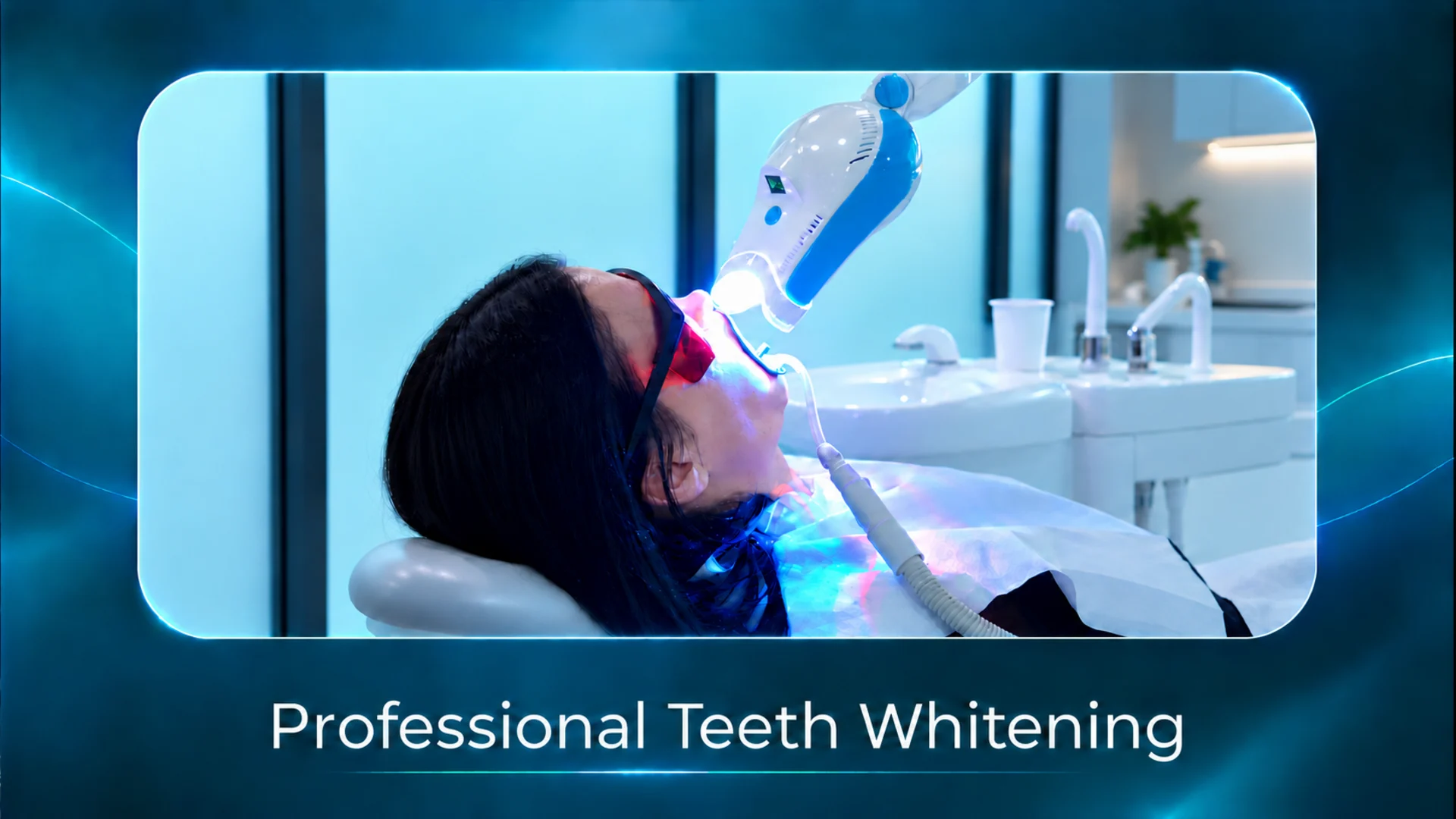
What Is Professional Teeth Whitening?
Professional teeth whitening is a cosmetic dental treatment used to lighten the shade of natural teeth. Whitening products commonly contain hydrogen peroxide or carbamide peroxide, which break down coloured molecules within the tooth structure and make their appearance less concentrated.
Unlike veneers or crowns, teeth whitening does not change the shape of the teeth and does not require drilling or tooth preparation. It is intended to improve colour while preserving the existing natural tooth structure.
Professional teeth whitening may help reduce discolouration associated with:
- Coffee and tea.
- Red wine and strongly pigmented foods.
- Tobacco use.
- Natural changes in tooth colour over time.
- General yellowing of natural teeth.
- Certain surface and internal stains.
Not every type of discolouration responds in the same way. Yellow-toned teeth often respond more noticeably than grey or deeply discoloured teeth. The dentist evaluates the likely response before recommending treatment.
What Causes Teeth to Become Discoloured?
Tooth colour is influenced by the natural structure of the enamel and dentine as well as lifestyle, age, dental history and existing restorations.
SURFACE STAINS
Coffee, tea, red wine, tobacco and strongly coloured foods can leave deposits on the surface of the teeth.
Some surface stains can be reduced through professional cleaning, while others may require whitening to achieve a brighter overall shade.
NATURAL AGEING
Enamel can gradually become thinner and more translucent over time, allowing the naturally darker dentine beneath it to become more visible.
Whitening can help brighten the overall appearance, although every patient’s response is different.
MEDICATION-RELATED DISCOLOURATION
Some types of medication-related staining may be more difficult to whiten and can require a longer or combined treatment approach.
DENTAL TRAUMA
A tooth that has been injured can become darker than the surrounding teeth. When only one tooth has changed colour, standard full-mouth whitening may not be the most appropriate treatment.
ROOT-CANAL-TREATED TEETH
A root-canal-treated tooth may darken internally. Selected teeth may be suitable for internal whitening, which is different from conventional whitening applied to the outer tooth surface.
CROWNS, VENEERS AND FILLINGS
Dental restorations do not respond to whitening products. If visible crowns, veneers or fillings already match your current tooth shade, they may appear darker after the natural teeth have been whitened.
This should be discussed before treatment so that whitening and any future restorative work can be planned in the correct order.
Who Is Suitable for Teeth Whitening?
Professional teeth whitening may be suitable for adults who want to brighten natural teeth affected by general yellowing or responsive staining.
You may be suitable if you:
- Have healthy natural teeth and gums.
- Want to reduce yellowing or common lifestyle stains.
- Prefer a conservative aesthetic treatment without tooth preparation.
- Understand that results vary according to the starting shade.
- Do not have untreated tooth decay or gum disease.
- Are willing to follow the aftercare recommendations.
- Understand that whitening is not permanent.
- Have realistic expectations about the achievable shade.
Whitening may need to be postponed or modified if you have:
- Untreated cavities.
- Active gum disease.
- Cracked or damaged teeth.
- Exposed tooth roots.
- Significant existing sensitivity.
- Leaking or failing restorations.
- Extensive crowns, veneers or fillings in the visible smile.
- A type of discolouration unlikely to respond predictably.
If whitening is not likely to provide the desired improvement, your dentist may discuss alternatives such as composite bonding, veneers or crowns. These treatments should not be recommended automatically without first evaluating whether a more conservative option is suitable.
Professional Teeth Whitening Options
The most suitable whitening method depends on your starting shade, tooth sensitivity, available treatment time and desired result.
IN-CLINIC TEETH WHITENING
In-clinic whitening uses a professionally selected whitening gel applied under the supervision of a dentist.
The gums and surrounding soft tissues are protected before the gel is placed. The product may be applied in controlled cycles and refreshed during the appointment.
In-clinic whitening is often selected by international patients because visible brightening can usually be achieved during one appointment.
LASER OR LIGHT-ACTIVATED TEETH WHITENING
The term “laser teeth whitening” is commonly used for in-clinic systems in which a light source is used as part of the whitening protocol.
The whitening gel remains the main active component. Whether light activation is appropriate depends on the professional system used and the dentist’s clinical protocol.
Patients should not choose a whitening treatment based only on whether it is marketed as “laser whitening”. Assessment, gel concentration, tissue protection and sensitivity management are equally important.
DENTIST-SUPERVISED HOME WHITENING
Custom-fitted whitening trays can be produced for use at home with a whitening gel prescribed by the dentist.
Home whitening is applied gradually over a planned period. The concentration, frequency and duration are adjusted according to the product and the patient’s sensitivity.
COMBINED WHITENING
Some patients may benefit from an in-clinic session followed by dentist-supervised home whitening.
This approach may provide greater control over the final shade and can also support future maintenance. It is not required for every patient.
INTERNAL WHITENING
Internal whitening may be considered when one root-canal-treated tooth has become darker than the surrounding teeth.
The whitening material is placed inside the tooth by a dentist and reviewed over a series of appointments. This is a separate procedure from standard whitening of the complete smile.
Professional Teeth Whitening Procedure: Step by Step
CONSULTATION
Tell us what you would like to change about your smile and whether you have previous sensitivity, whitening experience or visible dental restorations.
If you are travelling for other dental treatments, whitening can be considered within the broader treatment sequence.
DENTAL EXAMINATION
The dentist checks your teeth, gums, existing fillings, crowns and veneers. Any tooth decay, gum disease or other dental problem that could affect whitening should be identified first.
The cause and distribution of the discolouration are also evaluated.
PROFESSIONAL CLEANING WHEN REQUIRED
Plaque, tartar and surface deposits can affect the appearance of the teeth and the consistency of the whitening result.
If necessary, professional cleaning is completed before whitening. Cleaning removes external deposits, while whitening changes the shade of the natural teeth.
STARTING SHADE RECORD
Your initial tooth shade is recorded before treatment. Clinical photographs or a shade guide may be used to document the starting point and compare the visible change afterwards.
The final result cannot be selected with the same precision as the shade of a crown or veneer because every natural tooth responds differently to whitening.
GUM AND SOFT-TISSUE PROTECTION
A protective barrier is carefully applied around the gums and other soft tissues before the whitening gel is placed.
This helps reduce contact between the gel and the surrounding tissues.
WHITENING GEL APPLICATION
The whitening gel is applied to the visible surfaces of the natural teeth. Depending on the selected professional system, the gel may be applied in several controlled cycles.
A light source may be used when it forms part of the chosen protocol.
RINSING AND SENSITIVITY ASSESSMENT
The whitening material is removed and the teeth are rinsed. The dentist checks the gums, evaluates sensitivity and provides any recommended desensitising care.
FINAL SHADE AND AFTERCARE
The immediate shade change is reviewed and aftercare instructions are provided.
The appearance can change slightly as the teeth rehydrate following the procedure, so the final shade should not be judged only during the first few minutes after treatment.
How Long Does Teeth Whitening Take in Turkey?
Professional in-clinic teeth whitening can often be completed during a single appointment. The appointment length depends on the whitening system, number of application cycles and the patient’s sensitivity.
This makes teeth whitening a convenient option for international patients who are already visiting Istanbul for a holiday, dental examination or another treatment. A prolonged stay in Türkiye is generally not required for in-clinic whitening.
Dentist-supervised home whitening takes place more gradually and may continue after the patient returns home. Your dentist explains how frequently and for how long the gel should be used.
Patients with deep discolouration or a dark root-canal-treated tooth may require additional appointments or a different treatment method.
How White Can Professional Whitening Make My Teeth?
The amount of brightening varies according to the natural tooth shade, type of staining, enamel and dentine structure, age and previous dental treatment.
Professional whitening can produce a visible improvement, but a specific number of shades cannot be guaranteed before treatment.
The aim is to achieve a brighter version of your natural tooth colour rather than creating an artificial opaque white. Natural teeth have different levels of translucency and small variations in colour, and these characteristics remain after whitening.
If you would like a shade or tooth shape that whitening cannot provide, veneers or crowns may be discussed. These treatments alter the tooth surface and should only be considered after the conservative alternatives have been evaluated.
Does Teeth Whitening Cause Sensitivity?
Temporary tooth sensitivity is one of the most common effects of teeth whitening. Some patients experience no sensitivity, while others may notice short, sharp sensations when consuming cold drinks or breathing in cool air.
Sensitivity is usually temporary and commonly improves after the whitening treatment is paused or completed.
The likelihood and intensity can be influenced by:
- Existing tooth sensitivity.
- Exposed root surfaces.
- Fine cracks or worn enamel.
- Whitening gel concentration.
- Length and frequency of application.
- The individual response of the teeth.
At DIS Levent International, your sensitivity history is discussed before treatment. The dentist may adapt the treatment protocol, shorten application cycles or recommend desensitising products when appropriate.
Contact the clinic if sensitivity is severe, persistent or affects one particular tooth more than the others, as this may indicate an underlying dental problem requiring assessment.
How Much Does Teeth Whitening Cost in Turkey?
The cost of teeth whitening in Turkey depends on the selected method, whether custom trays are required and whether professional cleaning or other dental care is needed first.
Factors that can affect the price include:
- In-clinic whitening.
- Dentist-supervised home whitening.
- A combined in-clinic and home whitening plan.
- Custom-fitted whitening trays.
- The professional whitening system selected.
- Professional cleaning before whitening.
- Desensitising care.
- Internal whitening for a single dark tooth.
- Additional dental treatment required before whitening.
An advertised “laser teeth whitening price” may not explain whether the examination, cleaning, custom trays or follow-up care are included.
TRANSPARENT TREATMENT PLAN
You receive clear information about the proposed whitening method, treatment stages and cost before proceeding.
If examination identifies decay, gum disease or another condition that should be treated first, the reason and any additional cost are discussed with you. No additional treatment is carried out without your knowledge and approval.
How Long Do Teeth Whitening Results Last?
Teeth whitening is not permanent. Natural teeth can gradually become darker again as they continue to be exposed to food, drinks, tobacco and normal ageing.
The duration of the result varies according to:
- Coffee and tea consumption.
- Red wine and strongly pigmented foods.
- Smoking and tobacco use.
- Daily brushing and interdental cleaning.
- Professional dental cleaning.
- The original cause of the discolouration.
- The whitening method used.
- Dentist-supervised maintenance or touch-up treatments.
Some patients maintain a brighter shade for a long period, while others require more frequent touch-ups because of their habits.
Whitening should not be repeated excessively. Your dentist can advise when a touch-up is appropriate and how to reduce the risk of sensitivity or gum irritation.
Teeth Whitening Aftercare
Your dentist provides instructions according to the whitening system used and your individual sensitivity.
General recommendations may include:
- Brushing twice daily with fluoride toothpaste.
- Cleaning between the teeth every day.
- Avoiding tobacco products.
- Rinsing with water after coffee, tea or red wine.
- Limiting strongly pigmented foods and drinks for the short period recommended by your dentist.
- Avoiding extremely hot or cold foods if sensitivity occurs.
- Using a sensitivity toothpaste if recommended.
- Following the prescribed schedule when using home whitening trays.
- Keeping whitening gel away from children and pets.
- Not increasing the amount or frequency without professional guidance.
- Attending regular examinations and professional cleaning.
Home whitening trays and gels should only be used according to the instructions provided. Using more product or leaving it in place for longer does not guarantee a better result and can increase sensitivity or gum irritation.
Teeth Whitening Limitations and Important Considerations
Professional whitening is a conservative treatment, but it does not work in the same way for every patient or every tooth.
Important considerations include:
- Crowns, veneers, bridges, implants and fillings do not become lighter.
- Existing restorations may no longer match after the natural teeth are whitened.
- Deep grey, medication-related or trauma-related discolouration may respond less predictably.
- A single dark tooth may require a different treatment approach.
- Untreated decay and gum disease should be addressed first.
- Temporary tooth sensitivity can occur.
- Temporary gum irritation can occur if whitening material contacts the soft tissues.
- Results cannot be guaranteed to reach a specific shade.
- Whitening is not permanent and may require future maintenance.
- Excessive or unsupervised use can increase sensitivity and irritation.
If you are planning veneers, crowns or bonding, whitening should generally be considered before the final restoration shade is selected. Your dentist will advise how the procedures should be sequenced and how long the shade should be allowed to stabilise.
Why Choose DIS Levent International for Teeth Whitening in Istanbul?
Professional teeth whitening should begin with an examination rather than simply applying the strongest available product.
At DIS Levent International, your natural tooth shade, type of discolouration, sensitivity and existing dental work are evaluated before the whitening method is selected.
DENTIST-SUPERVISED WHITENING
Your teeth and gums are assessed by a dentist before treatment. Whitening is carried out with controlled professional products and appropriate protection for the surrounding soft tissues.
PERSONALISED TREATMENT INTENSITY
Not every patient requires the same gel concentration, application time or number of cycles.
Your protocol can be adjusted according to your starting shade, existing sensitivity and response during treatment.
REALISTIC SHADE PLANNING
We do not promise an identical shade for every patient. Your dentist explains how your type of discolouration is likely to respond and whether whitening can reasonably achieve your preferred result.
The objective is a brighter, healthy-looking smile that remains compatible with your natural teeth and visible restorations.
MULTIDISCIPLINARY DENTAL TEAM
Tooth discolouration can sometimes be related to decay, gum disease, dental trauma, root-canal treatment or ageing restorations.
At DIS Levent International, professionals working across aesthetic dentistry, restorative dentistry, endodontics and periodontology can assess these requirements within the same clinic. You do not need to visit different centres if an additional dental concern is identified.
CONSERVATIVE TREATMENT APPROACH
When tooth colour is the main concern, professional whitening may provide an improvement without preparing the natural teeth for veneers or crowns.
If whitening is not suitable, the alternatives and their effects on the natural teeth are explained before a treatment decision is made.
TRANSPARENT PRICING
The proposed whitening method and included services are explained clearly before treatment begins.
If cleaning, restorative treatment or another procedure is required first, this is discussed separately so that you understand the complete plan and cost.
INTERNATIONAL PATIENT SUPPORT
A member of our international patient team remains available to assist with appointments and communication.
Our English-speaking doctors and multilingual interpreters help you explain your expectations, previous sensitivity and treatment concerns clearly. You can ask questions and understand each stage without worrying about a language barrier.
Teeth Whitening Before and After Results
Explore before-and-after cases from patients who received professional teeth whitening and other personalised aesthetic treatments at DIS Levent International.
The degree of whitening varies according to the patient’s starting shade, enamel and dentine structure and type of discolouration. Photographs represent individual outcomes and do not guarantee that another patient will achieve the same shade.
Images should be taken under consistent lighting and camera conditions to provide a more reliable comparison.
Frequently Asked Questions About Teeth Whitening in Turkey
How does professional teeth whitening work?+
Professional whitening products usually contain hydrogen peroxide or carbamide peroxide. These agents break down coloured molecules within the teeth, making the overall shade appear brighter.
Is professional teeth whitening safe?+
Teeth whitening is generally considered safe when the teeth and gums are examined first and the treatment is supervised by a dental professional.
Using products too frequently or without appropriate guidance can increase the risk of sensitivity and gum irritation.
What is laser teeth whitening?+
Laser teeth whitening is a commonly used name for an in-clinic whitening method in which a professional gel is combined with a light source according to the selected system.
The whitening gel is the active component. The dentist determines whether a light-activated protocol is appropriate for your teeth.
Is laser teeth whitening better than normal whitening?+
Not necessarily for every patient. The result depends on the whitening gel, starting shade, type of discolouration, application protocol and individual tooth response.
The most suitable method should be selected after a dental examination rather than according to the word “laser” alone.
How long does professional teeth whitening take?+
In-clinic whitening can often be completed during one appointment. The exact duration depends on the product, number of application cycles and your sensitivity.
Home whitening takes place more gradually over the period prescribed by the dentist.
Do I need to stay in Turkey after teeth whitening?+
A prolonged stay is generally not required. In-clinic whitening can often be completed during a single visit, making it suitable for patients visiting Istanbul for a short trip or another dental treatment.
How much does teeth whitening cost in Turkey?+
The cost depends on whether you receive in-clinic whitening, custom home trays, combined whitening or internal whitening for one tooth.
Professional cleaning or necessary dental treatment before whitening can also affect the total cost. You receive clear pricing before the procedure begins.
How many shades whiter will my teeth become?+
The result varies from patient to patient. Starting shade, type of staining, enamel and dentine structure and previous dental treatment all influence the response.
A specific number of shades cannot be guaranteed before treatment.
Will whitening make my teeth unnaturally white?+
Professional whitening brightens the natural teeth but does not make them opaque or change their shape. Your natural translucency and individual tooth characteristics remain visible.
The objective is a brighter version of your natural shade.
Does teeth whitening hurt?+
Whitening should not normally cause procedural pain, but temporary sensitivity can occur during or after treatment.
The dentist can adapt the application protocol and recommend sensitivity management when required.
Can I have whitening if I already have sensitive teeth?+
Possibly. The cause and severity of the sensitivity should be assessed first.
Your dentist may recommend a modified whitening protocol, shorter application periods or desensitising care. Untreated cavities, cracks or exposed roots should be addressed before whitening.
Will teeth whitening change the colour of crowns or veneers?+
No. Whitening products lighten natural tooth structure but do not change the shade of crowns, veneers, bridges, implants or fillings.
Visible restorations may need to be reviewed if they no longer match the natural teeth after whitening.
Should I whiten my teeth before veneers or crowns?+
Whitening is often considered before the shade of a new veneer, crown or filling is selected. This allows the restoration to be matched to the brighter natural teeth.
Your dentist determines the correct sequence and allows the tooth shade to stabilise before final colour matching.
Can teeth whitening remove every type of stain?+
No. Yellow and common lifestyle-related discolouration may respond well, while grey, trauma-related or medication-related stains can be more resistant.
Your dentist can explain whether whitening, bonding, veneers or another treatment is more appropriate.
Can one dark tooth be whitened?+
Yes, but a single dark tooth may require a different approach. A root-canal-treated tooth may be suitable for internal whitening, while trauma-related discolouration requires a careful clinical and radiographic assessment.
Is professional cleaning the same as whitening?+
No. Professional cleaning removes plaque, tartar and some external surface stains. Whitening uses bleaching agents to lighten the natural tooth shade.
Some patients need cleaning before whitening to improve oral health and create a more consistent result.
How long do teeth whitening results last?+
Results are not permanent. Their duration depends on coffee, tea, red wine, smoking, oral hygiene and individual tooth characteristics.
Professional cleaning and dentist-supervised touch-ups can help maintain the result.
Can I repeat teeth whitening?+
Yes, but whitening should not be repeated too frequently. Your dentist should evaluate your current shade, sensitivity and oral health before recommending a touch-up.
Can I whiten my teeth at home after returning home?+
Dentist-supervised home whitening may be possible using custom trays and prescribed gel. Follow the recommended amount, frequency and application time.
Do not extend the treatment or increase the gel concentration without consulting your dentist.