What Are E-max Veneers?
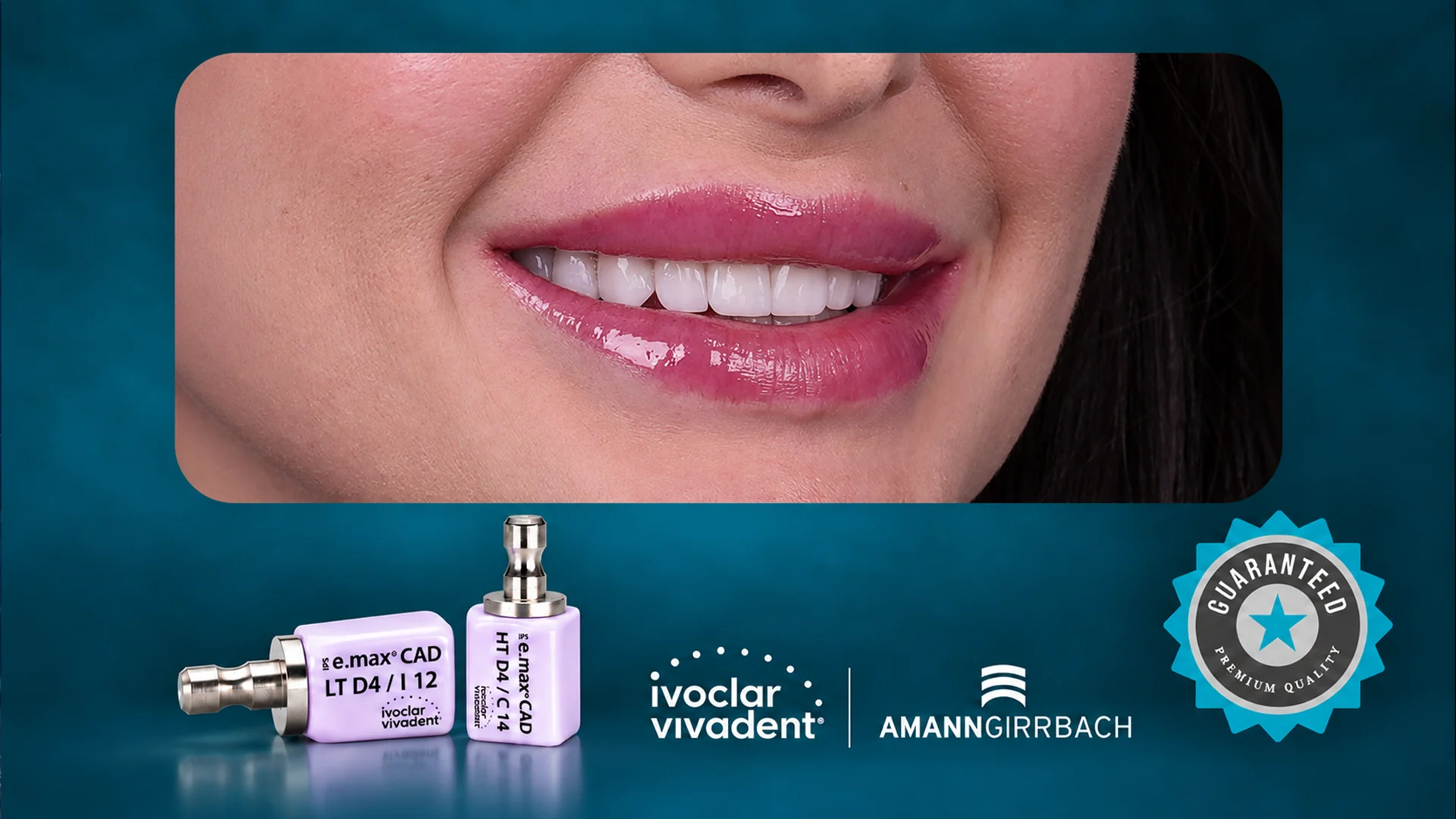
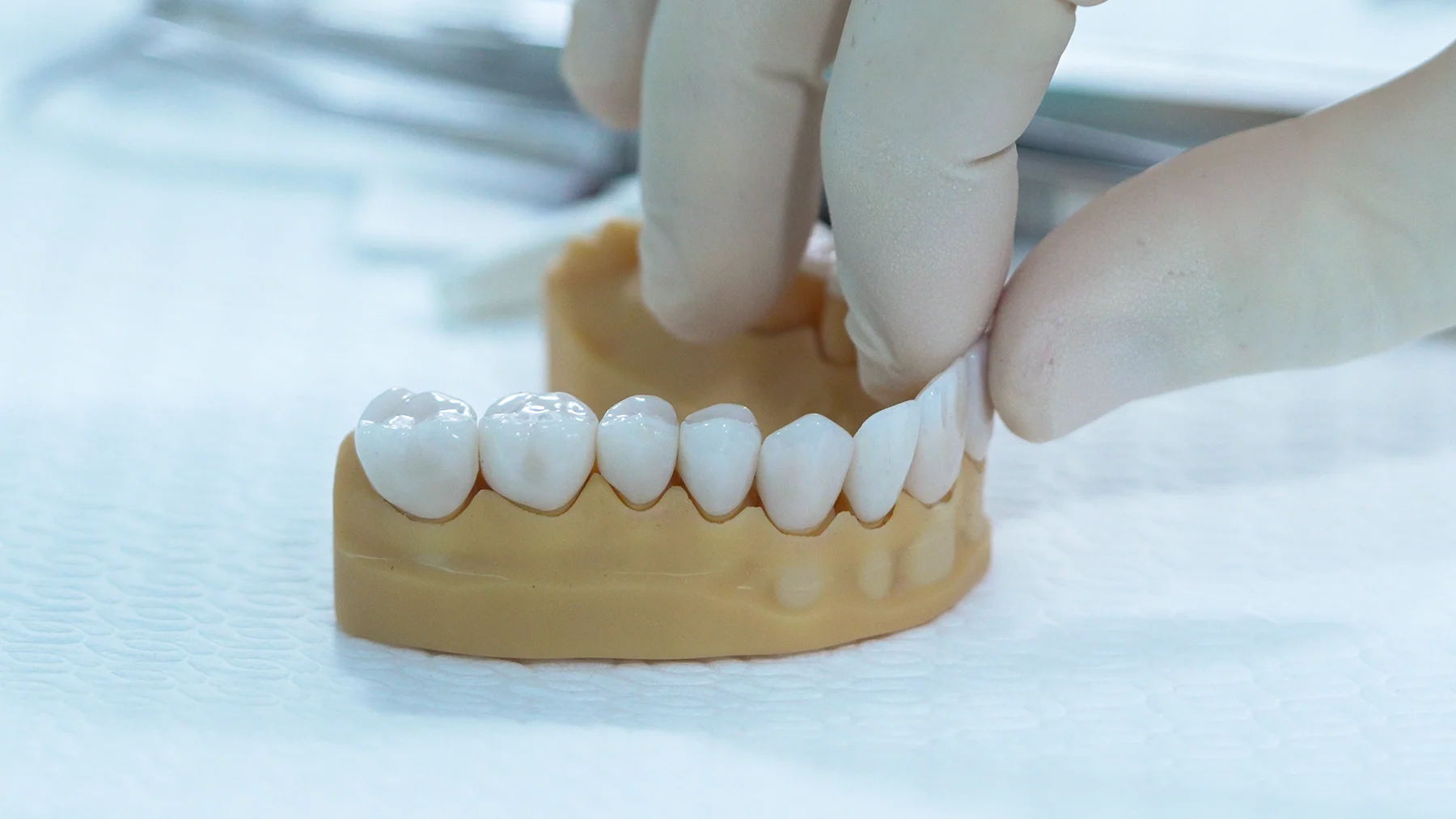
E-max veneers are thin, custom-made ceramic restorations bonded to the front surface of teeth. They are commonly used to improve visible concerns involving tooth shade, shape, size, symmetry and small spaces between teeth.
E-max is a lithium disilicate glass-ceramic developed for metal-free dental restorations. Its optical properties allow the laboratory to control translucency, brightness and shade so that the restoration can reflect light in a way that resembles natural tooth enamel.
Unlike a dental crown, a veneer does not surround the entire tooth. It primarily covers the visible front surface, which usually allows the dentist to preserve more natural tooth structure when the tooth is otherwise healthy.
E-max veneers may be considered for:
- Teeth that remain discoloured after whitening.
- Small gaps between front teeth.
- Chipped or worn tooth edges.
- Teeth that appear short, narrow or uneven.
- Mild irregularities in visible tooth position.
- Old or discoloured restorations on front teeth.
- Patients seeking a natural-looking smile makeover.
- Patients who want to improve several visible teeth together.
A veneer cannot correct every dental concern. Active decay, gum disease, significant misalignment, severe tooth damage and an unstable bite should be addressed before aesthetic veneer treatment.
Who Is Suitable for E-max Veneers?
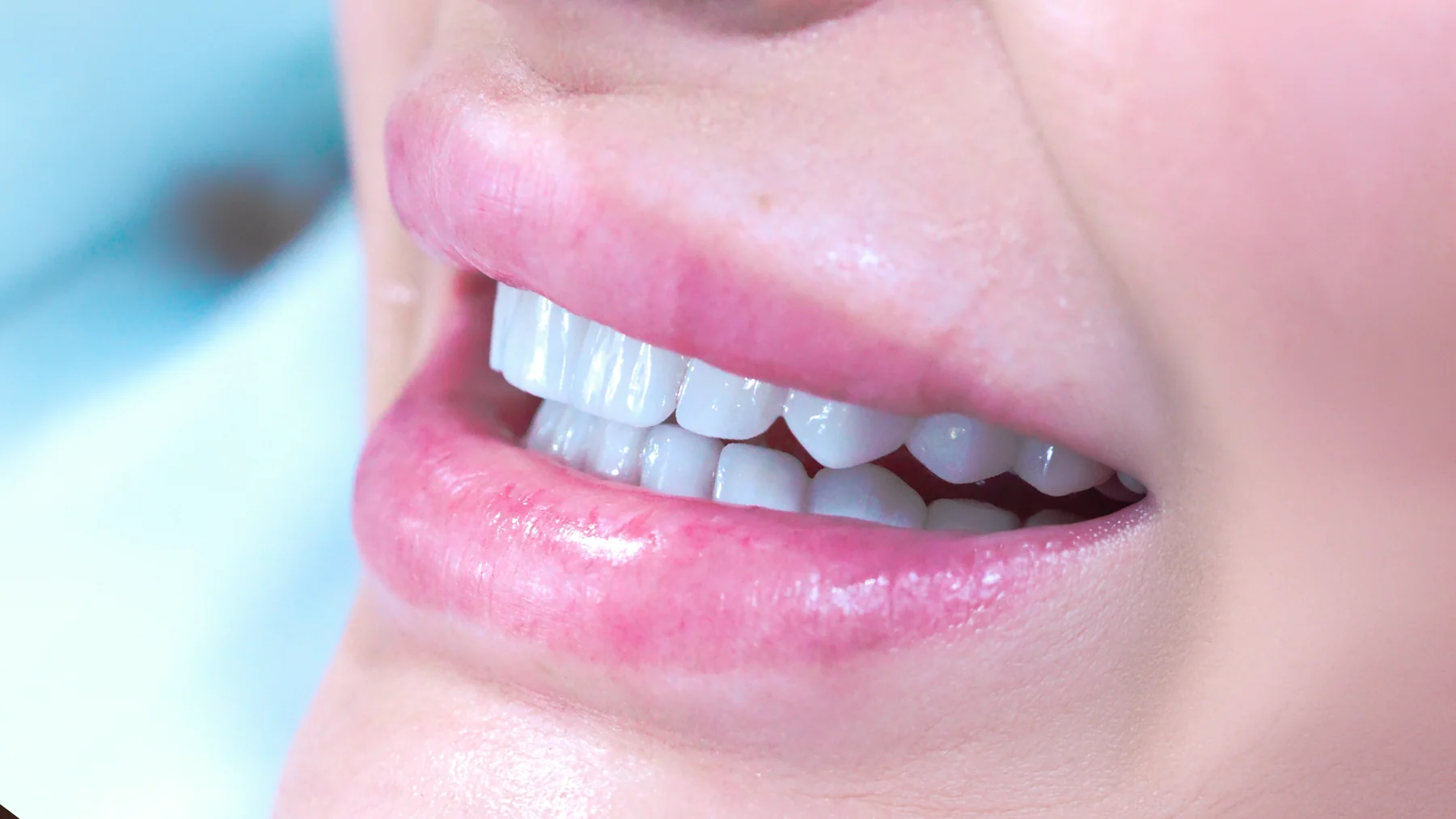
E-max veneers are generally considered for patients whose front teeth are healthy enough to support an adhesively bonded ceramic restoration but require improvement in colour, shape or proportion.
You may be suitable if you:
- Have healthy teeth and gums.
- Want to improve the appearance of visible front teeth.
- Have staining that does not respond sufficiently to whitening.
- Have small chips, spaces or shape irregularities.
- Have enough healthy enamel for reliable bonding.
- Maintain effective daily oral hygiene.
- Have realistic expectations about the possible result.
- Are willing to attend regular dental examinations.
- Do not have uncontrolled teeth grinding or an untreated bite problem.
Veneers may not be the first treatment recommended if your concern can be managed more conservatively with whitening, composite bonding or orthodontics. Teeth that are severely weakened, heavily restored or root-canal treated may require a crown rather than a veneer.
Suitability is determined tooth by tooth. One patient’s treatment plan may combine E-max veneers, bonding, crowns, whitening or orthodontic treatment rather than applying the same restoration to every visible tooth.
Are E-max Veneers the Same as Laminate Veneers?
A laminate veneer describes the type and shape of the restoration: a thin ceramic layer bonded to the front surface of a tooth. E-max describes the ceramic system or material from which the veneer can be produced.
This means that an E-max veneer is a type of porcelain laminate veneer made using lithium disilicate glass-ceramic.
Other materials and techniques may also be used to produce laminate veneers. The appropriate option depends on:
- The existing tooth shade.
- The amount of colour change required.
- The position and shape of the tooth.
- Available enamel for bonding.
- Bite forces and teeth grinding.
- The thickness required for the planned result.
- The dentist’s and dental technician’s selected workflow.
The material should be selected according to the needs of the individual tooth rather than applying one type of restoration throughout every smile makeover.
Learn More About Laminate Veneers in Turkey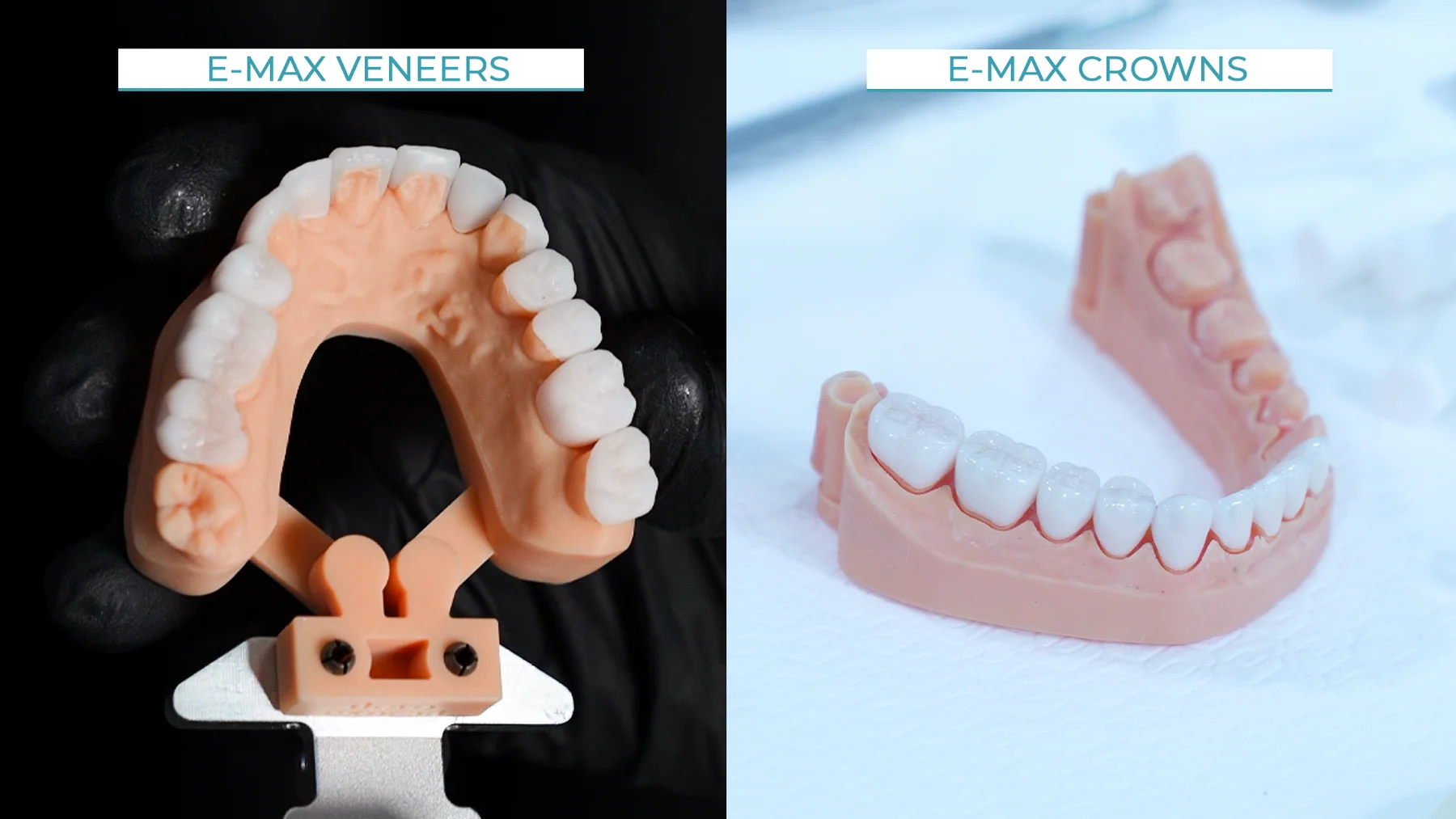
E-max Veneers vs E-max Crowns: What Is the Difference?
E-max veneers and E-max crowns may be produced using the same lithium disilicate material, but they do not cover the tooth in the same way and are not used for the same clinical purpose.
E-MAX VENEER
An E-max veneer covers mainly the front surface of the tooth. It is generally considered when the tooth is structurally healthy but requires an aesthetic change in shade, shape, length or proportion.
Because the restoration covers a limited surface, preparation is usually more conservative than preparation for a full crown.
E-MAX CROWN
An E-max crown surrounds the visible part of the tooth. It may be considered when more tooth structure has been lost or when the tooth requires greater coverage.
Crowns may be used for teeth with extensive restorations, fractures or other structural concerns. Their suitability depends on the remaining tooth structure, bite and position of the tooth.
WHICH ONE DO I NEED?
The decision should not be made according to the material name alone. Your dentist first determines whether the tooth needs a veneer or a crown and then selects an appropriate material.
Healthy teeth should not automatically be prepared for crowns simply because a full smile makeover is requested. At DIS Levent International, each tooth is evaluated separately and the more conservative suitable treatment is discussed whenever possible.
Explore E-max Crowns in Turkey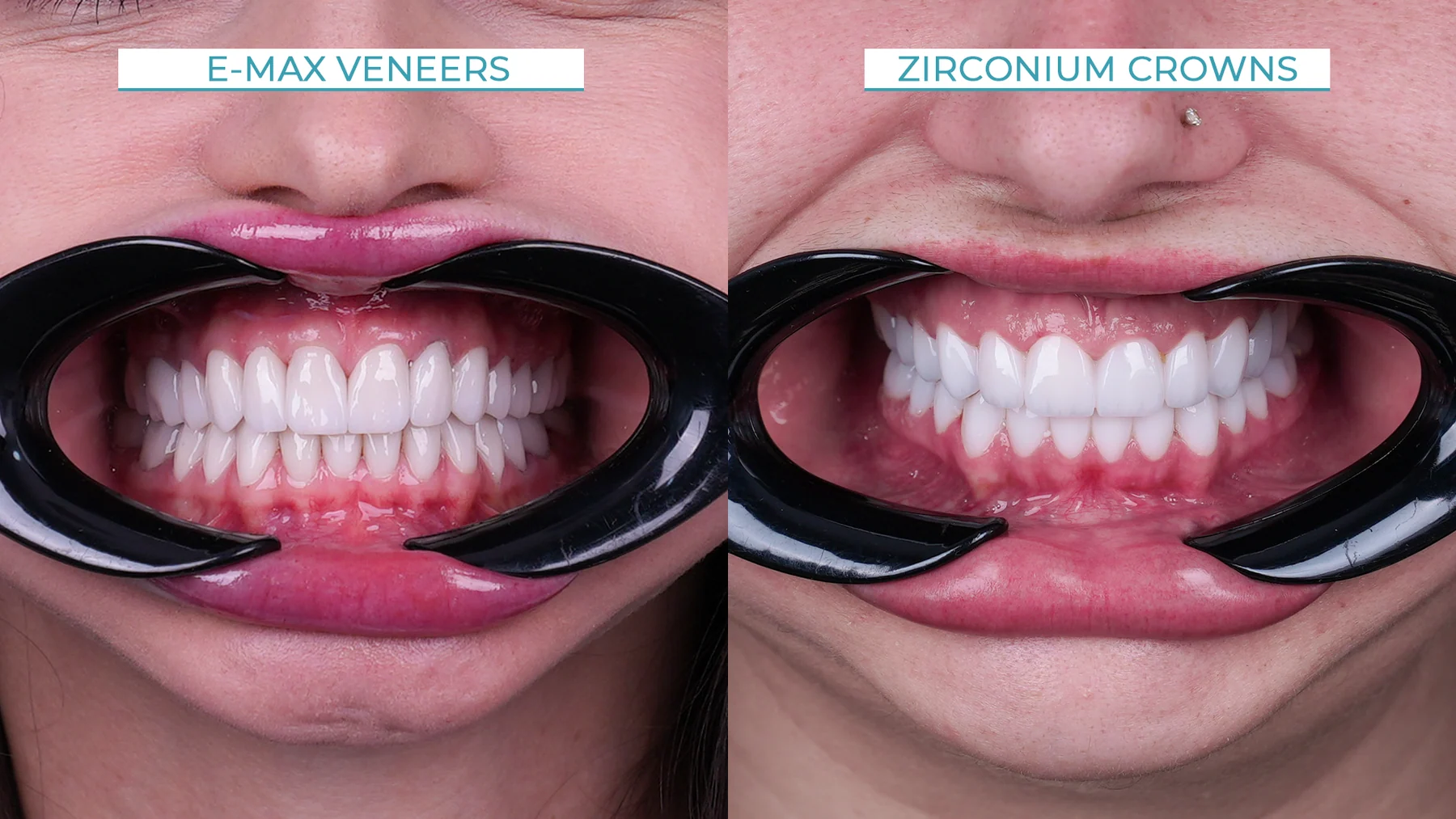
E-max Veneers vs Zirconium Crowns
E-max veneers and zirconium crowns can both be used within aesthetic dentistry, but they differ in coverage, material properties and clinical indication.
E-MAX VENEERS
E-max veneers are thin lithium disilicate restorations bonded primarily to the front surface of a tooth. They are commonly considered for front teeth when preserving natural tooth structure and controlling translucency are important.
ZIRCONIUM CROWNS
Zirconium crowns cover the visible tooth more completely. They may be considered when greater coverage is required, when the tooth has significant structural loss or when the treatment area is exposed to higher functional demands.
Modern monolithic zirconia can also provide natural-looking results when shade, shape, surface texture and translucency are planned carefully.
THE MATERIAL IS SELECTED TO MATCH THE TOOTH
E-max is not automatically the best material for every tooth, and zirconia is not automatically required for every smile makeover.
Some patients may receive E-max veneers on healthy front teeth and zirconium crowns on teeth that require greater coverage. The aim is to choose the most appropriate restoration for each tooth while creating a consistent smile.
Compare Zirconium Crowns in Turkey
Personalised E-max Veneers-Not Standard “Turkey Teeth”
One of the biggest concerns international patients have is ending up with artificial-looking “Turkey teeth”. We understand that you may be worried about teeth appearing too white, too large, too uniform or unsuitable for your face.
At DIS Levent International, your E-max veneers are designed individually according to your facial proportions, skin tone, lips, existing teeth and preferred result. Shade, translucency, surface texture and tooth shape are discussed with you because every face is different and every smile should be different too.
A natural smile does not necessarily mean choosing the whitest shade or creating perfectly identical teeth. Small variations in form, texture and translucency can help the final restoration appear more lifelike.
The treatment plan may combine different procedures rather than using E-max veneers on every visible tooth. Whitening, bonding, crowns, gum treatment or orthodontics may be recommended when they provide a more appropriate result for a particular tooth.
E-max Veneers Procedure in Turkey: Step by Step
REMOTE SMILE ASSESSMENT
Before travelling, share clear photographs of your smile and any recent dental X-rays or treatment records you have available.
Our clinical team reviews your concerns and prepares an initial treatment outline. The suggested number of veneers and preliminary quotation are confirmed only after your physical examination.
CLINICAL EXAMINATION
Your dentist examines your teeth, gums, existing restorations and bite. X-rays or additional imaging may be used when required.
Decay, gum disease, infection or bite-related concerns should be identified and addressed before veneers are bonded.
DIGITAL RECORDS AND SMILE PLANNING
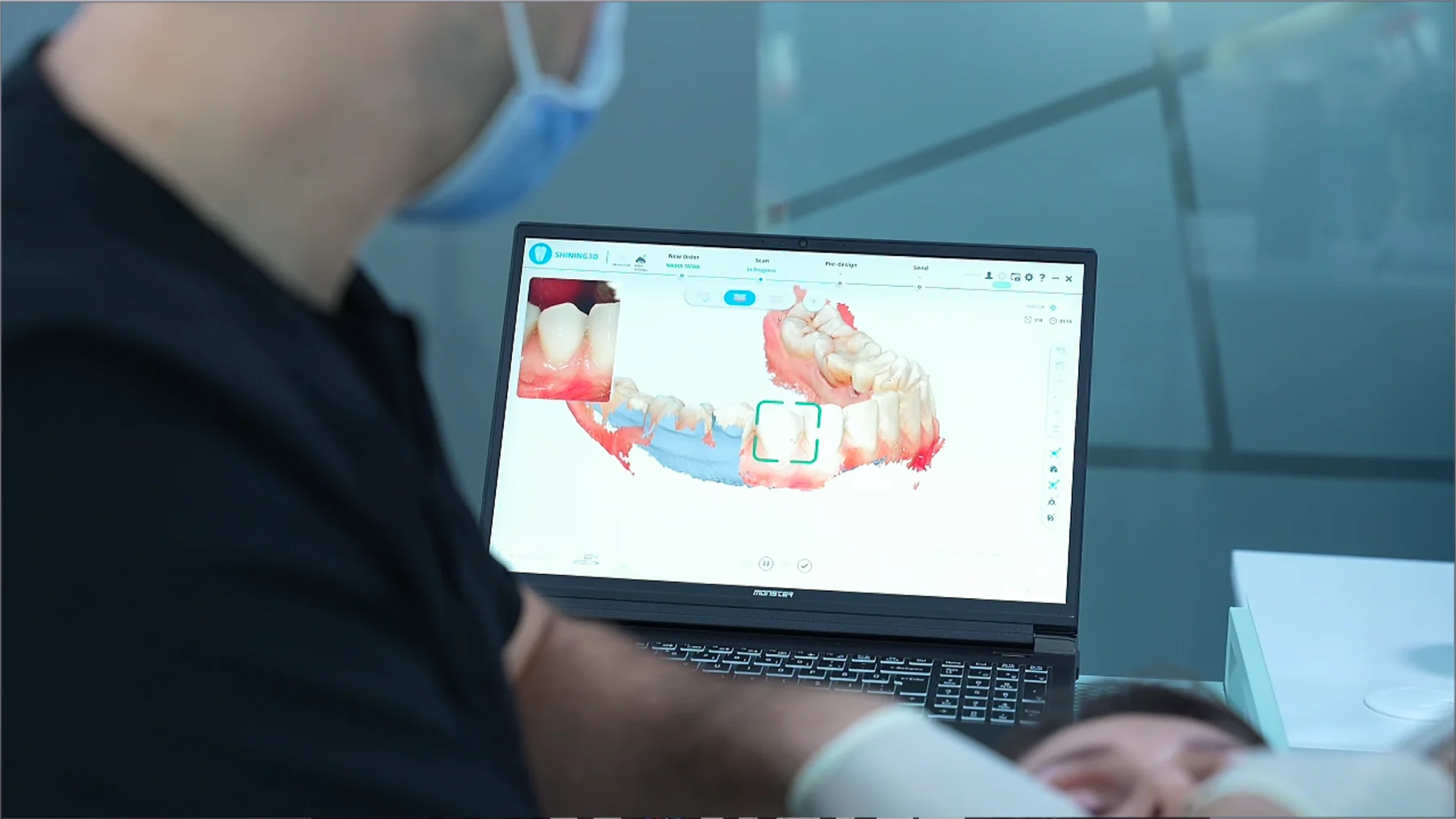
Digital scans, clinical photographs and bite records are taken. Tooth shape, length, shade and proportions are planned in relation to your face and smile.
Your expectations are discussed before tooth preparation begins. Digital smile planning supports communication but does not guarantee an identical clinical result.
MOCK-UP OR DESIGN REVIEW
When appropriate, a mock-up can be used to help you evaluate the proposed tooth proportions before the final restorations are produced.
This stage allows the dentist to review tooth length, smile width, lip support and speech while giving you an opportunity to communicate what you like or would prefer to change.
TOOTH PREPARATION
A controlled amount of enamel is prepared to create space for the veneers and support an appropriate fit.
The amount varies from patient to patient. Some teeth require very little preparation, while others require more to correct their position, shade or shape. No-preparation veneers may be possible in selected cases but should not be promised before examination.
Local anaesthesia can be used to keep the procedure comfortable.
DIGITAL IMPRESSIONS AND TEMPORARY VENEERS
After preparation, detailed digital scans are taken and sent to the dental laboratory.
Temporary veneers may be provided to protect the prepared teeth and help you adapt to the planned shape while the final restorations are produced.
TRY-IN AND AESTHETIC REVIEW
The E-max veneers are placed temporarily so that their shape, shade, translucency, margins and relationship with the lips can be evaluated.
The bite and speech are also checked. Necessary adjustments are discussed before permanent bonding.
FINAL BONDING
Once the veneers have been approved, the tooth and ceramic surfaces are prepared according to the bonding protocol. Each veneer is bonded individually.
Excess cement is removed, the margins are polished and the bite is checked carefully.
FINAL APPOINTMENT
The veneers, bite and gum relationship are reviewed, and personalised aftercare instructions are provided.
E-max veneer treatment is commonly completed in approximately five to seven working days. This allows international patients to complete the treatment during one planned visit without needing to remain in Türkiye for an extended period.
If you require gum treatment, orthodontics, root-canal treatment or another preliminary procedure, the overall schedule may be longer.
How Long Do E-max Veneers Take in Turkey?
E-max veneer treatment is usually completed within approximately five to seven working days. The exact schedule depends on the number of veneers, the condition of the teeth and gums, the amount of preparation and any requested design changes.
A typical schedule may include:
FIRST APPOINTMENT
Clinical examination, dental imaging where required, digital scans, photographs and smile planning.
DESIGN AND PREPARATION
The planned tooth shapes are reviewed. The teeth are prepared conservatively, digital impressions are taken and temporary veneers may be fitted.
LABORATORY STAGE
The E-max veneers are produced and individually characterised according to the approved design.
TRY-IN
Shape, shade, translucency, fit, bite and speech are checked. Adjustments can be made before the veneers are bonded.
FINAL APPOINTMENT
The veneers are bonded, the bite is checked and aftercare instructions are provided.
Most international patients can complete these stages during one visit to Istanbul. Your coordinator will explain how many days you should allow before arranging your return flight.
How Much Do E-max Veneers Cost in Turkey?
The cost of E-max veneers in Turkey depends on the number of teeth treated, complexity of the smile design and any additional dental care required before the veneers can be placed.
Factors affecting the total cost may include:
- The number of E-max veneers.
- Whether the upper teeth, lower teeth or both are treated.
- Existing fillings, crowns or veneers.
- The condition of the teeth and gums.
- The amount of preparation required.
- Additional gum treatment or contouring.
- Root-canal treatment where clinically necessary.
- The complexity of the laboratory design and characterisation.
- Temporary veneers.
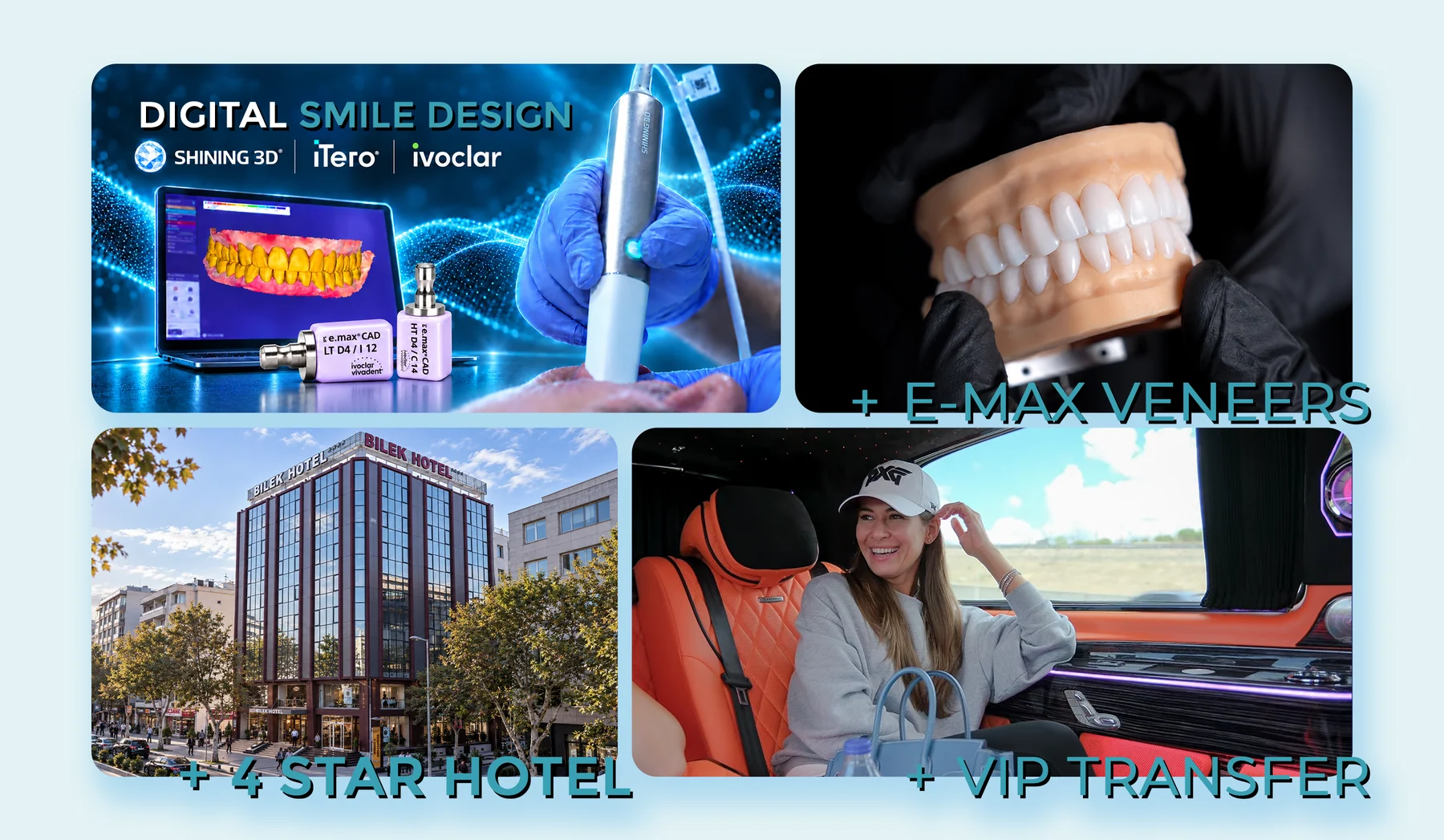
- Transfers, accommodation or other travel services included in the plan.
Patients should compare more than the advertised price per veneer. The dentist’s assessment, material traceability, laboratory workflow, temporary restorations, try-in process and aftercare should also be considered.
TRANSPARENT TREATMENT PLAN
Before travelling, you receive a preliminary treatment plan and itemised quotation based on the photographs and dental records you provide.
Possible additional treatments that could affect the cost are discussed in advance. This helps prevent unexpected changes when you arrive.
The final plan is confirmed following your clinical examination in Istanbul. When the submitted records accurately reflect your current dental condition, the confirmed price will normally remain close to the preliminary quotation. Any necessary changes are explained before treatment continues.
Why Do International Patients Choose E-max Veneers in Turkey?
International patients may choose E-max veneers in Turkey because private aesthetic dental treatment can be more accessible than comparable treatment in the UK, Europe or the United States.
Lower operating and laboratory costs can reduce the overall treatment price, but cost should not be the only factor when selecting a clinic.
Patients may also consider Istanbul because of:
- Clinics experienced in treating international patients.
- Digital smile-planning and scanning technologies.
- Dental laboratories experienced in aesthetic ceramic restorations.
- Coordinated treatment schedules for limited travel periods.
- Multidisciplinary dental teams.
- Direct international flight connections.
- Accommodation, transfer and multilingual support services.
- The possibility of completing treatment during one planned visit.
Treatment quality varies between clinics in every country. Patients should verify the treating dentist, exact veneer material, tooth-preparation approach, laboratory process, written quotation and aftercare arrangements before making a decision.
Benefits of E-max Veneers
NATURAL-LIGHT TRANSMISSION
Lithium disilicate glass-ceramic offers different levels of translucency and opacity. This helps the dentist and laboratory create a restoration that interacts with light in a way that can resemble natural enamel.
CONSERVATIVE TOOTH PREPARATION
Because a veneer covers mainly the front surface of the tooth, treatment can generally preserve more natural tooth structure than a full crown when the tooth is suitable.
The exact amount of preparation remains individual and should only be confirmed after examination.
INDIVIDUAL SHADE AND SHAPE CONTROL
Shade, translucency, surface texture, edge character and tooth proportions can be personalised. The design can range from naturally bright to a whiter and more defined aesthetic, depending on your preference and clinical suitability.
METAL-FREE RESTORATION
E-max veneers do not contain a metal framework. This supports natural optical properties and avoids a metal-related grey appearance at the edge of the restoration.
RESISTANCE TO SURFACE STAINING
The glazed ceramic surface is more resistant to staining than natural enamel. However, plaque and superficial stains can still collect around the veneer margins, making daily cleaning and professional maintenance important.
INDIVIDUAL RESTORATIONS
Each veneer is bonded separately. If one veneer later requires replacement, the neighbouring veneers do not automatically need to be removed.
E-max Veneer Aftercare and Maintenance
E-max veneers do not require a special daily routine, but the natural teeth and gums around them must remain healthy.
Recommended care includes:
- Brushing twice daily with a soft toothbrush.
- Using a non-abrasive fluoride toothpaste.
- Cleaning between the teeth every day.
- Attending regular examinations and professional cleaning.
- Avoiding biting fingernails, ice and other hard objects.
- Avoiding opening packaging with your teeth.
- Contacting your dentist if the bite feels uneven.
- Having persistent sensitivity or gum irritation assessed.
- Wearing a protective night guard if recommended.
Whitening products do not change the shade of ceramic veneers. If you are considering whitening your remaining natural teeth, this should be discussed before the veneer shade is selected.
NIGHT GUARD FOR GRINDING OR CLENCHING
Teeth grinding and clenching can place excessive forces on ceramic restorations. If signs of bruxism are identified, a protective night guard may be recommended and provided by our clinic.
The guard is produced after the final veneers have been placed so that it fits the new tooth positions accurately and helps protect the restorations from excessive night-time forces.
E-max Veneer Risks and Important Considerations
E-max veneers are a long-term dental treatment and should only be planned after the teeth, gums and bite have been assessed.
Important considerations include:
- Some enamel preparation is required in many cases.
- Tooth preparation cannot be reversed.
- Temporary sensitivity may occur after preparation or bonding.
- A veneer can chip, crack, loosen or require replacement.
- Natural teeth can still develop decay around veneer margins.
- Gum inflammation can occur if cleaning is inadequate.
- Significant grinding or bite problems can increase fracture risk.
- The final appearance is influenced by the underlying tooth shade.
- Existing dental problems must be treated before veneers are placed.
- Future maintenance or replacement may eventually be required.
These considerations do not mean E-max veneers are unsuitable for most patients. They underline the importance of conservative preparation, correct bonding, stable bite forces and regular maintenance.
No responsible clinic can guarantee that a veneer will last for life. Long-term performance depends on treatment planning, available enamel, laboratory quality, bite, oral hygiene and patient habits.
Why Choose DIS Levent International for E-max Veneers in Istanbul?
Natural-looking veneers depend on more than selecting a ceramic material. Diagnosis, tooth preparation, smile design, laboratory communication, bonding and bite adjustment must all work together.
At DIS Levent International, your treatment is coordinated from the first remote assessment to the final clinical checks and aftercare.
CONSERVATIVE, TOOTH-BY-TOOTH PLANNING
We do not assume that every visible tooth requires a veneer. Whitening, composite bonding, orthodontics or a crown may be more suitable for some teeth.
Each tooth is assessed individually so that the treatment plan can preserve healthy dental tissue wherever clinically possible.
PERSONALISED SMILE DESIGN
Your veneers are planned according to your facial proportions, skin tone, lip movement, natural tooth display and preferred aesthetic.
Rather than applying one standard shape and shade to every patient, we discuss the details that make a smile individual-including translucency, tooth texture, incisal character and small natural variations.
DIGITAL DENTISTRY
Digital scans and clinical photographs provide detailed records of your teeth, gums and bite. These records support communication between the dentist and dental laboratory throughout the planning and production stages.
Digital planning can help you understand the proposed design, but the clinical result is confirmed through the mock-up, try-in and final assessment stages.
OUR DENTAL LABORATORY
Technology, precision and craftsmanship come together to create personalised dental restorations planned for natural aesthetics, comfortable function and an accurate fit.
Direct communication between the clinical and laboratory teams allows shade, surface texture, tooth shape and other design details to be reviewed throughout production.
MULTIDISCIPLINARY DENTAL TEAM
Aesthetic veneer treatment may sometimes require gum care, restorative treatment, root-canal treatment or orthodontic assessment before the final restorations are placed.
While patients at some clinics may need to visit different centres for these services, DIS Levent International provides access to professionals working across aesthetic dentistry, periodontology, endodontics and orthodontics within the same clinic.
This helps the relevant teams coordinate your treatment rather than assessing each requirement separately.
TRANSPARENT TREATMENT PLAN
You receive a preliminary plan and itemised quotation before travelling. The suggested number of veneers, possible additional treatment and included services are explained clearly.
Your final treatment plan is confirmed after the clinical examination. If a finding requires a change, the reason and its effect on the treatment or cost are discussed before proceeding.
INTERNATIONAL PATIENT SUPPORT
A member of our international patient team remains available throughout your treatment journey.
Our English-speaking doctors and multilingual interpreters help you communicate your concerns and preferences clearly. This allows you to discuss details such as shade, tooth shape and expected result without feeling that your requests are being lost in translation.
The international patient team also remains available after you return home and directs clinical questions to the relevant dentist when required.
E-max Veneers Before and After Results
Explore before-and-after cases from patients who received E-max veneers and other personalised aesthetic dental treatments at DIS Levent International.
Every patient has a different starting tooth position, shade, facial structure and clinical requirement. Photographs represent individual patient outcomes and do not guarantee that another patient will receive the same result.
During your consultation, the clinical team can show you cases that are more relevant to your dental condition and preferred smile style.
Frequently Asked Questions About E-max Veneers in Turkey
What are E-max veneers made from?+
E-max veneers are produced using lithium disilicate glass-ceramic. This metal-free material is available in different levels of translucency and opacity, allowing the restoration to be adapted to the underlying tooth shade and desired aesthetic result.
Are E-max veneers the same as porcelain veneers?+
E-max veneers are a type of porcelain or all-ceramic veneer. The term porcelain veneer is broader and can include restorations produced from different ceramic systems. E-max refers to a specific ceramic material family.
Are E-max veneers the same as laminate veneers?+
An E-max veneer can be described as an E-max laminate veneer. “Laminate veneer” describes a thin restoration bonded to the front surface of a tooth, while E-max identifies the ceramic material used to produce it.
Do teeth need to be shaved for E-max veneers?+
Some tooth preparation is required in many cases, but it is generally more conservative than preparation for a crown. The amount depends on tooth position, existing shade and the planned change.
Selected teeth may be suitable for no-preparation or very minimal-preparation veneers. This can only be confirmed following an examination and should not be promised from photographs alone.
Will my teeth be filed down into small points?+
Veneer preparation is different from full-crown preparation. An E-max veneer mainly covers the front surface, so the tooth should not normally be reduced in the same way as a full crown.
The amount of preparation remains case-specific. Your dentist should explain which surfaces will be prepared and why before treatment begins.
Do E-max veneers look natural?+
They can produce a natural-looking result when translucency, shade, shape, texture and tooth preparation are planned carefully. The final appearance also depends on the underlying tooth colour and laboratory characterisation.
A personalised result should complement your face rather than simply making every tooth identical or selecting the brightest available shade.
How many E-max veneers do I need?+
The number depends on your smile width, lip movement, visible teeth, existing restorations and goals. Some patients require only four or six veneers, while a wider smile may involve eight, ten or more visible teeth.
Only teeth that affect the visible smile and are suitable for veneer treatment should be included. Your treatment plan should show what is proposed for each tooth.
How long does E-max veneer treatment take in Turkey?+
Treatment is commonly completed within approximately five to seven working days. This includes examination, digital records, preparation, laboratory production, try-in and final bonding.
Additional dental or gum treatment may extend the schedule.
How much do E-max veneers cost in Turkey?+
The total cost depends on the number of veneers, complexity of the design, condition of the teeth and any preparatory treatment required. DIS Levent International provides an itemised preliminary quotation after reviewing your photographs and available dental records.
Are E-max veneers better than zirconium crowns?+
Neither material is universally better. E-max veneers are generally considered when healthy front teeth require a conservative aesthetic change. Zirconium crowns may be selected when a tooth requires greater coverage or has lost more structure.
The appropriate restoration should be selected for each tooth rather than using the same material throughout the mouth.
Can E-max veneers close gaps between teeth?+
E-max veneers can close selected small spaces by adjusting tooth width and proportion. Larger gaps or gaps caused by tooth-position and bite problems may be better treated with orthodontics or a combined approach.
Can E-max veneers correct crooked teeth?+
They can improve the appearance of mild irregularities, but veneers do not physically move teeth. Moderate or severe crowding may require orthodontic treatment.
Using veneers to mask substantial misalignment can require unnecessary tooth preparation, so the alternatives should be discussed first.
Can I choose the veneer shade?+
Yes. Shade selection is discussed with you using your preferences, skin tone, natural teeth and desired level of brightness.
The aim may be a subtle natural improvement or a brighter smile, but the selected shade should also work with the material thickness and underlying tooth colour.
Do E-max veneers stain?+
The ceramic surface is more resistant to staining than natural enamel. However, superficial deposits and staining can collect around the margins over time.
Daily cleaning and regular professional maintenance help protect both the appearance of the veneers and the health of the surrounding gums.
How long do E-max veneers last?+
E-max veneers are designed for long-term use, but their lifespan varies. Bonding quality, enamel support, bite forces, teeth grinding, oral hygiene and habits all influence longevity.
A veneer may eventually require re-bonding or replacement. Regular dental reviews help identify problems before they become more extensive.
What happens if an E-max veneer chips?+
The appropriate solution depends on the size and location of the damage. Minor surface damage may sometimes be polished or repaired, while a more significant fracture may require the veneer to be replaced.
Because veneers are placed as individual restorations, replacing one unit does not automatically require replacing the surrounding veneers.
Is E-max veneer treatment painful?+
Local anaesthesia can be used during tooth preparation, so patients should not experience procedural pain. Mild sensitivity may occur temporarily after preparation or bonding.
Persistent pain, increasing sensitivity or a bite that feels uneven should be assessed by a dentist.
Can I have E-max veneers if I grind my teeth?+
Possibly, but the bite and severity of grinding must be assessed carefully. Active bruxism can increase the risk of chipping or fracture.
Your plan may involve bite adjustment, an alternative restoration or a protective night guard. When indicated, the night guard is provided after your final restorations are fitted.